Explosive meningitis outbreak is unprecedented, officials say

 PA Media
An outbreak of meningitis that has killed a university student and a sixth former is unprecedented, health chiefs have said.
The number of confirmed cases of invasive meningitis in the Canterbury area stands at 15, with a targeted vaccination programme announced at the University of Kent.
Two people have died - a 21-year-old university student and Juliette, a sixth form pupil at Queen Elizabeth's Grammar School in Faversham.
Professor Susan Hopkins, chief executive of the UK Health Security Agency (UKHSA), said there was an "explosive nature" to the outbreak, while deputy chief medical officer Dr Thomas Waite said it was the quickest growing outbreak he had seen in his career.
Earlier, Health Secretary Wes Streeting described it as an unprecedented outbreak and a "rapidly developing situation".
Hopkins said it looked as though there had been a super spreader event, with the outbreak ongoing within university halls of residences, where there would have been parties and social mixing.
She said she could not yet confirm where the initial infection came from.
The UKHSA declared a national incident on Sunday to help ensure supplies of antibiotics, BBC health correspondent Nick Triggle said.
But its not a sign that the outbreak is spreading beyond Kent, he added.
Instead, it is a operational tool to allow the authorities to flex national resources.
Hopkins said in her 35 years in medicine, it was the most cases she had seen in a single weekend with this type of infection.
"It's the explosive nature that is unprecedented here - the number of cases in such a short space of time," she added.
About 5,000 students in university halls in Kent are to be offered the meningitis B vaccine, with the aim to prevent further disease in several weeks' time if somebody has been harbouring the infection.
Health officials have confirmed vaccinations will start on Wednesday.
Five schools in the county have confirmed or suspected cases and hundreds of people are being offered antibiotics as an immediate treatment.
Across the country, worried parents and students have been trying to get the jab privately, but pharmacists told the BBC they have either run out of stock or are down to their last supplies.
 Keeleigh Goodwin
Keeleigh Goodwin is recovering in hospital from meningitis after collapsing in her flat.
It is believed she caught the illness at Club Chemistry, the Canterbury nightclub where the outbreak is thought to have originated.
The 21-year-old, who works in a restaurant, said: "I've still got a headache and aching. It's going back down my legs."
She added that she had cuts up to her face from having a seizure.
Her mother, Kharli Goodwin, told the BBC her daughter's life had been saved by her flatmates.
She said she woke up on Sunday morning to missed calls and voicemails saying Keeleigh had been taken to hospital after collapsing in her flat.
She said her daughter was "delirious".
"She didn't know what was going on. She couldn't speak. She couldn't see," Goodwin said.
Goodwin added she had been left "petrified" by the experience.
"She [Keeleigh] doesn't want to go out again for a long time," the mother said.
"How does this happen in this day and age?"
Four of the 15 cases are confirmed to be meningitis B, the UKHSA said.
MenB is the most common cause of meningococcal meningitis in the UK, but routine vaccinations were only rolled out in 2015, meaning the current generation of students and others in their late teens are not covered.
The government has said that jabs may be offered more widely as the UKHSA assesses ongoing risk to other populations.
 Family handout
Laboratory scientists are urgently trying to work out if the spread was caused by a possible mutant strain of menB.
The genome of the menB strain identified in the outbreak is undergoing whole genome sequencing to see if there are any differences to known strains.
It will also be tested against available menB vaccines, though experts stressed people should get a jab if eligible.
More than 30,000 people across Canterbury have been contacted by the UKHSA, which called the outbreak "particularly large".
Streeting told the House of Commons on Tuesday that the figures would be updated publicly by UKHSA each day at 09:30 GMT.
Prof Anjan Ghosh, director of public health at Kent County Council, said he wanted to reassure the public that the outbreak was not like Covid-19.
"It is not a pandemic where it spreads like wildfire," he told BBC Radio Kent.
"It takes quite a lot of prolonged contact for the bacteria to spread from one person to another."
The government is not advising schools to close, although some in parts of Kent have shut.
The five schools with confirmed or suspected cases are Queen Elizabeth's Grammar School in Faversham, Norton Knatchbull School and Highworth Grammar School in Ashford, Simon Langton Grammar School for Boys in Canterbury and the Canterbury Academy.
Highworth Grammar School said on Tuesday that a Year 13 student was in hospital with a suspected case of meningitis.
"We are supporting all our students regarding this update, taking specific precautionary measures on hygiene and sharing key information regularly with the school community," it said.
An email to parents and carers at the Canterbury Academy, seen by the BBC, said that a student in Year 13 was being treated for meningococcal disease and was responding well to treatment with antibiotics.
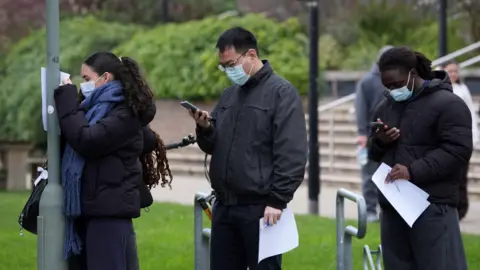
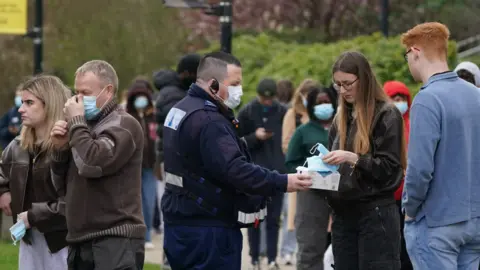
Students continued to queue to receive antibiotics at the University of Kent on Tuesday.
George Doubtfire, who studies film, told the BBC that many students were leaving the campus and heading home.
Another student, Crystal MacPherson, said she was planning to stay indoors.
"People have died - it is quite crazy," the 21-year-old added.
Dr Leyla Hannbeck, of the Independent Pharmacies Association, said pharmacies, particularly in Kent, were seeing a "surge in demand" for private jabs.
But she said unfortunately stocks were running out, while some places had none left.
 PA Media
The UKHSA has urged anyone who visited Club Chemistry between 5 and 7 March to come forward for preventative antibiotic treatment as a precautionary measure.
The University of Kent has said its campus will remain open, despite all scheduled assessments for the next few days being cancelled.
Antibiotics will also be available at the Gate Clinic at Kent and Canterbury Hospital, Westgate Hall in Canterbury and the Carey Building at Thanet Hub in Westwood.
Follow BBC Kent on Facebook, on X, and on Instagram. Send your story ideas to southeasttoday@bbc.co.uk or WhatsApp us on 08081 002250.
