The 'secret' and mysterious world of moss picking
Hidden among the clouds that cling to the Cambrian mountains, Graham has brought me to a secret location, armed with a home-made rake.
He is the third generation of commercial moss collectors in his family, in a business that stretches back to the 1950s.
Demand has doubled in recent years, with customers buying his moss for hanging baskets in spring and Christmas wreaths in winter, as well as vivariums to keep geckos and iguanas happy all year round.
However, a study by Bangor University suggests the number of professional pickers in Wales had fallen from around 50 in 2003 to just 20, as they compete with global imports and tightening regulation.

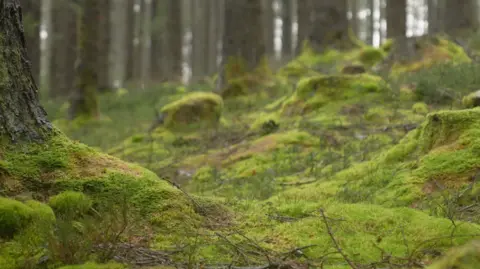
Like a lot of farmers, 54-year-old Graham Wilson from Dylife in Powys juggles a few different businesses, one of which involves heading up into the mistier fields and forests, whatever the weather.
He was following in the damp footsteps of his forefathers, who started picking wild moss more than 70 years ago.
"My grandfather used to take moss down on horse and cart to the local station in Machynlleth for it to go to cities like Liverpool and Manchester," Graham said.
"Then after 12 months they managed to save enough to buy a little van and then they bought a little lorry to take the moss."
Decades on, Graham has kept the family business going and collects up to 10,000 bags a year, competing with international imports from China, Chile and New Zealand.
The manual work of picking moss essentially remains exactly the same.
"Nothing has changed," he said.
"Just rake it and bag it."
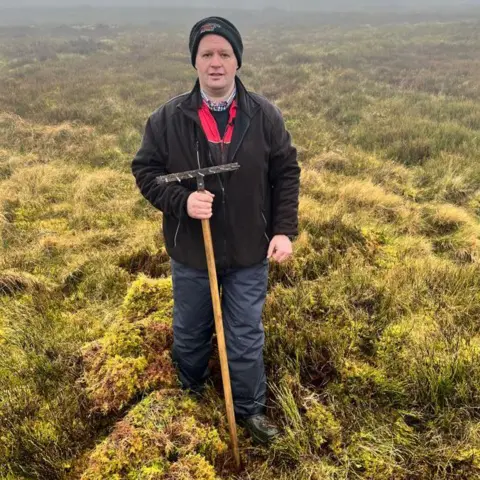
Graham has allowed me to join him on the proviso that we do not give away the exact picking location, as the landowner, who must give permission for moss to be collected, does not want it made public.
This air of mystery is not unfamiliar in the moss world.
When Jenny Wong from Bangor University set about trying to study the industry, she found numbers were in decline, down to around 20 commercial pickers in Wales.
However, most of them didn't want to take part in her research - she believed they did not want to reveal their activities or commercial know-how to strangers.
"A few didn't want us disturbing their work. People who like being up in the mountains in the rain are sometimes not the most sociable of people," she suggested.
What Wong did find was a tradition that stretched back over a century.
"Moss harvesting probably started in Wales as far back as World War One when it was used in war dressings and continued since then," she explained.
"Wales is the premier place for moss harvesting in the UK, at one time there were lorry loads going into the European market.
"We have a competitive advantage because we have ideal conditions for growing it."
Tightening regulation and environmental concerns over sphagnum - the bog moss that turns to peat - have brought changes, but commercial gathering of common moss remains legal in Wales provided pickers have a permit.
Natural Resources Wales (NRW), which manages public woodlands, says it has no plans to ban moss harvesting.
But it now requires a lot more information from gatherers to grant permission.
"We have to assess the possibility of an application on a case-by-case basis," said Fred Kehoe, a senior land management officer for NRW.
That means more admin, getting precise locations and information from the collectors who have traditionally worked on trust.
"The time it takes us to look at the sites they want to work and monitor their activities is also a factor," Kehoe explained.
"So how much staff resource we have to put towards it, but we're not against it."
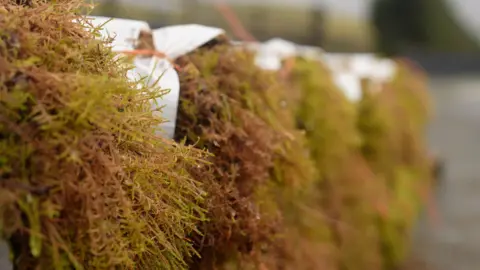
After a worrying wait, Graham recently had his permit renewed to gather moss at the nearby Hafren forest, where he harvests around a quarter of his supply.
While he recognises the need to work with the authorities, he believes collectors need more support as part of a traditional, sustainable industry that could flourish again.
"It has been a secret industry but now the demand is there for the moss," Graham said.
He had also noticed that supply is growing.
"The climate is changing, winter is wetter, summer is drier and warmer and moss seems to be growing faster," he said.
"It used to take five years to grow back, now after three years you can pick it again."
By the time we return to Graham's farm, we are both soaked from hours spent in the drizzle.
He's been willing to give me a glimpse of his world, knowing other collectors would prefer to keep things quiet.
Does he socialise much with the mysterious moss fraternity?
"We do get on," he replied cautiously.
"But we don't mix so much together - everyone's got their own patch."
