'Grave concerns' for original Bramley apple tree

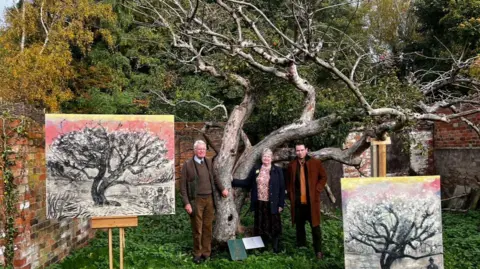 Dan Llywelyn-Hall
The great grandson of a man who introduced the Bramley apple commercially has said he is "gravely concerned" about the future of the fruit's original tree, as its site goes up for sale.
The back garden of a row of cottages in Southwell, Nottinghamshire, is home to the world famous Bramley, which grew from a pip planted more than 200 years ago.
Nottingham Trent University (NTU) has owned the Bramley Cottages in Church Street since 2018, when it renovated the site into student accommodation for its nearby Brackenhurst campus.
However, the university said it had put the site up for sale as "due to their age and configuration the cottages are not as suitable as other NTU-owned accommodation".
'Rich history'
It is believed Mary Ann Brailsford planted the Bramley pip between 1809 and 1815, when she lived in the cottages with her parents.
About 50 years later, gardener Henry Merryweather came across its fruit when the garden was owned by Matthew Bramley.
Believing it was unique, he was given permission to take cuttings from the Bramley Seedling and since then, it has become one of Britain's best loved cooking apples.
Roger Merryweather, Henry Merryweather's great grandson, said he was "gravely concerned" about the tree, which had such a "rich history".
He said: "This is a chance seedling.
"A one-million-to-one chance of something like this happening and it's incredible that it's still alive.
"I was at an event at St James's Palace and Prince Philip asked to speak to me. He said, 'because of your family we have Bramleys at Sandringham'."
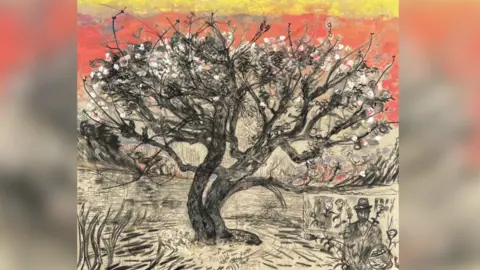 Dan Llywelyn-Hall
NTU has been responsible for the tree's upkeep since 2018, which has been extensive due to the Bramley being diagnosed with incurable honey fungus.
However, the university's decision to put the tree's site up for sale has led to concerns about its future.
Dan Llywelyn-Hall, founder of the Mother Bramley Fund, set up to protect the Bramley's legacy, said: "The structure of the tree is wonderful and it tells a story in every twist and turn of the bark.
"The fact that it is literally connected, rooted, to Southwell is so unique.
"We just want the new owners to understand they are about to be the custodian of a tree which is of great significance to our country and we are very much willing to work with them.
"But, my biggest worry is that they might not be sympathetic to that."
However, NTU has said it was committed to ensuring the tree will remain in the care of a "responsible custodian".
"The university aims to also support them with guidance on how to care for the tree moving forward," a NTU spokesperson added.
Follow BBC Nottingham on Facebook, on X, or on Instagram. Send your story ideas to eastmidsnews@bbc.co.uk or via WhatsApp on 0808 100 2210.
