'Collusive behaviour' reports must include line that police ombudsman exceeded powers

 Liam McBurney/PA Wire
Police Ombudsman reports which found collusive behaviour by RUC officers in a series of loyalist murders must include a notice about the watchdog exceeding its legal powers, a High Court judge has ruled.
Mr Justice Scoffield acknowledged the public statements should not be formally quashed or completely withdrawn from publication.
But he held a further form of words was required to reflect previous rulings that former Ombudsman Marie Anderson acted "ultra vires" by reaching conclusions which amounted to determination of misconduct.
He said: "I consider that a strengthened form of notice should be included with the published reports…giving some indication of the court's core findings."
The final outcome was reached in a legal challenge by the Northern Ireland Retired Police Officers Association to the contents of three separate reports into Troubles-era killings.
The association has been locked in a long-running legal attempt to have the public statements declared unlawful.
One of the cases focused on a probe into a series of loyalist paramilitary murders in the south Belfast area between 1990 and 1998.
 Pacemaker
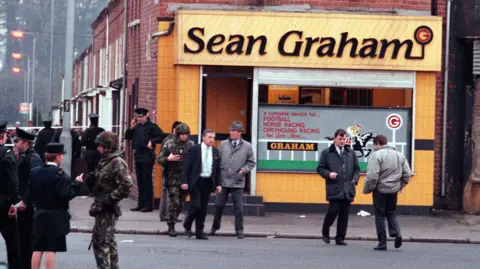
In 2022 Anderson found evidence of "collusive behaviour" by police in the attacks, which included the February 1992 massacre at the Sean Graham betting shop on the Ormeau Road where UDA gunmen shot dead five Catholic victims.
Legal action was also taken over the report into the police handling of loyalist killings in the northwest region from 1989 to 1993.
A third challenge related to findings in the case of four men wrongly accused of murdering a British soldier in Londonderry.
Known as the Derry Four, the ombudsman concluded that RUC officers had unfairly obtained confessions from them for the killing of Lt Stephen Kirby in the city in 1979.
The four men later fled Northern Ireland until their acquittal in 1998.
Guilty of colluding in terrorist murders without due process
The retired RUC officers claimed Anderson was legally forbidden from making findings which effectively branded them guilty of colluding in brutal terrorist murders without proper due process.
A Court of Appeal judgement in 2020 restricted her scope to accuse former policemen and women of the criminal offence of collusion with paramilitaries.
Those proceedings related to a previous case taken by retired senior policemen Raymond White and Ronald Hawthorne over the contents of former Ombudsman Dr Michael Maguire's report into the 1994 Loughinisland atrocity.
Acknowledging her limitations, Anderson said she had identified conduct within the RUC amounting to "collusive behaviours".
But the association argued that she misunderstood her permitted role and cannot use that term without establishing a malign motive.
The ombudsman had wrongly labelled all police working in those areas at the relevant times as complicit with the terrorists responsible for brutal campaigns of murder, it was contended.
Counsel representing the ombudsman hit back by suggesting the retired officers were becoming "collusion deniers".
He told the court she had carried out a forensic analysis to reach legally-sound findings, identifying behaviour indicative of collusion without being determinative.
'Not possible to put the genie back in the bottle'
In February last year, Mr Justice held that a distinction drawn by the ombudsman between "collusion" and "collusive behaviours" was either unsustainable or insufficiently clear.
She reached conclusions beyond a proper remit set out by the Court of Appeal in published reports which represented an extension of the ombudsman's role beyond its statutory bounds, he found.
Even though an appeal against the verdict is expected, lawyers on both sides were involved in further efforts to decide on any final order required in the case.
In court on Monday, Mr Justice Scoffield indicated there was agreement that the public statements should not be quashed or withdrawn entirely from publication.
"This was a pragmatic view on the part of the applicants, taken, at least partly, on the basis that the statements had been publicly available for some time," he said.
"It was not possible to put the genie back in the bottle."
However, he confirmed that a further notice is to feature in the reports.
Making a partial award of costs to the applicants, the judge added: "I consider that the just and proportionate approach."
