Legacy body chief 'regrets shortcomings' in the commission

 PA Media
The head of a body which investigates Troubles-related deaths has said "we weren't set up to do what we want to do".
Sir Declan Morgan's comments follow a "damning" review into the operation of the Independent Commission for Reconciliation and Information Recovery (ICRIR).
It began operating in May 2024, but the review found it already faces significant problems with financial management, leadership conflict and staff morale.
Morgan, who is ICRIR chief commissioner, said it had been a "difficult week" for the body, but the main question was whether it had been a "rough week" for victims and relatives.
Apology to staff
Following the publication of the review findings, Morgan said the body regretted the shortcomings.
On Friday, he said the ICRIR workforce was committed to the project of telling the truth and was "capable and competent".
He told BBC Radio Ulster's Talkback programme that he accepted the conclusions contained in the independent report published earlier this week and apologised to staff who felt they had not been supported.
Having spoken to staff, he said, he "wasn't altogether surprised" by the report's conclusions and had broadly reached the same himself by the time of its publication.
Morgan said it was troubling to him that the ICRIR had senior women among staff who felt they had been treated rudely.
He said the organisation was working with the report's author, Peter May, on a weekly basis to address this.
He said the report had found that some of the roles of senior leaders were not clearly defined and this was a factor in what happened.
This was not an excuse for disrespect, however, he added.
 Getty Images
'We have made mistakes'
Following the publication of the report, a former police ombudsman for Northern Ireland, Baroness Nuala O'Loan, said there was "something fundamentally very wrong" with the ICRIR.
She questioned the perceived lack of progress made by its staff to date.
"Investigation has to lead to reports and two years on, £60m spent, not one report," she said.
The former police ombudsman said she did not believe that staff relationships within the ICRIR were the main problem.
Instead, she claimed the organisation was deliberately "set up to fail" by the last government, which had limited its ability to carry out full investigations.
"When we were debating the [Troubles Legacy and Reconciliation] Act through parliament they removed the primary investigative powers at a late stage."
On Friday, Morgan said that Baroness O'Loan may not have understood some of the powers available to the ICRIR and in 90% of cases it did not need the sort of investigatory powers she had spoken about earlier this week.
He said he took her point about the legislation which underpins its work.
He said the first report from the ICRIR should be ready for sharing at the end of the month and three others had come through from the investigatory team.
The ICRIR had dealt with 123 cases to date, he said, and four reports will have been released by the end of the summer.
While the organisation had been "building at pace", he said, there was "no doubt we have made mistakes" along the way.
What is the ICRIR?
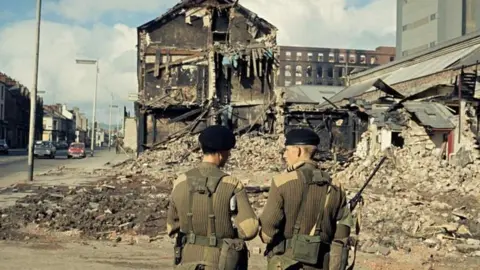
The ICRIR's main purpose is to investigate deaths and serious injuries during Northern Ireland's decades-long conflict known as the Troubles, in which more 3,600 people were killed and thousands more injured.
It was created by the previous Conservative government, despite strong objections from many victims' groups and all of Northern Ireland's political parties.
One of its main aims was to provide new information to bereaved families who are still seeking answers over their loved one's deaths.
When the Labour government came to power in 2024, it promised to repeal much of the Troubles Legacy Act, but it has supported the continuation of the ICRIR.
What did the review say?
The independent review was commissioned by the government following concerns about the ICRIR's corporate effectiveness and culture.
It found that the ICRIR's senior leadership team had become divided and this had had an impact on staff.
It identified concerns over "silo working" and said concerns had been raised about "toxic" and "disrespectful" interactions.
It raised questions over the ICRIR's financial management, as £60m has been spent so far with no completed investigation reports.
The review also revealed that some cases under investigation had to be "paused" because of a lack of resources.
