Bluebird return 'did what we set out to do'

 Martin Barraud/Getty Images
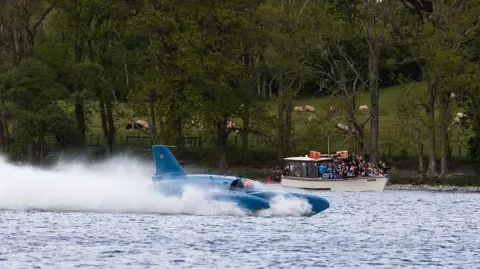
Organisers of the return of Donald Campbell's Bluebird K7 to Coniston Water say they "did what we set out to do" despite the restored craft's planned week-long running being severely hit by weather and technical woes.
It was the first time the hydroplane had been in action on the Cumbrian lake since 1967 when its pilot was killed attempting to push his world water speed record past 300mph (480km/h).
Some spectators were critical that mooted 150mph (240km/h) ventures did not happen, with only one run of 100mph (160km/h) on Friday.
But Tracy Hodgson, director of Coniston's Ruskin Museum which organised the event, said: "The plan was always to put her back on Coniston Water, which we did."
The event, advertised as Bluebird K7 - The Festival, is understood to have cost hundreds of thousands of pounds to stage due to factors including traffic management and a series of concerts that were cancelled.
Lake 'changes in seconds'
Billed as "weather dependent", with an exemption to the 10mph speed limit granted by the Lake District National Park Authority, up to eight runs were allowed each day.
But by the end, Bluebird only once achieved the speed needed to glide across the surface of the water, a process called planing.
"We're dealing with a lake that changes in seconds," Hodgson said.
"Safety has always been our main priority. We would never have run if the boat or the pilots were at risk.
"The engineering team did everything they possibly could on land, but until you put it on to the water and run it [you don't know what is going to happen]".
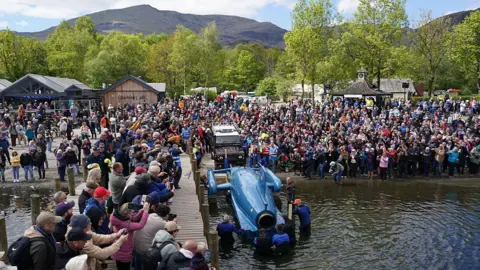
"We did what we set out to do. She planed and we took her round to Pier Cottage on Saturday evening [where Bluebird was launched the day Campbell was killed].
"That was always our objective."
 Ian Forsyth/Getty Images
Monday saw two slow-speed familiarisation runs for Australian pilot Dave Warby, son of current water speed record hold Ken Warby MBE, but Tuesday had none due to high winds.
Thunder and lightning hit the area on Wednesday and a lack of engine thrust meant Warby - himself a speed record challenger - was unable to plane until Friday following the fitting of a fuel boost pump.
Choppy conditions and a bent canopy catch then made running unsafe on Saturday, with winds and the starter hose coming off scuppering Sunday's efforts when alternate pilot DJ Gibbs was in the cockpit.
Return talk 'too soon'
Museum chairman Jeff Carroll described Coniston's weather as a "perennial challenge" and said spectators had been widely accepting of the difficulties being faced.
"We've done what we could. Everybody's pulled together. I think we've gelled well as a team.
"Would we have liked to have seen more runs? Yes, no question.
"Would we have liked to have seen her up to our limit of 150? Of course we would, but I think we haven't done bad."
Asked whether a similar event could be staged in upcoming years, Carroll added: "It's too soon to think about. I wouldn't rule it out.
"The good thing now is we understand what to do. We've got a blueprint."
In a post on Facebook, the festival team thanked "everyone who came to watch history being made and for the messages of support we have received".
They also praised Tyneside engineer Bill Smith and the Bluebird Project volunteers who recovered the craft in 2001 and led its rebuild.
Smith handed Bluebird to the Ruskin Museum two years ago following the resolution of a legal fight in which he claimed part-ownership of the craft.
