The village forever linked to Campbell's triumphs and tragedy

 John Hodgson
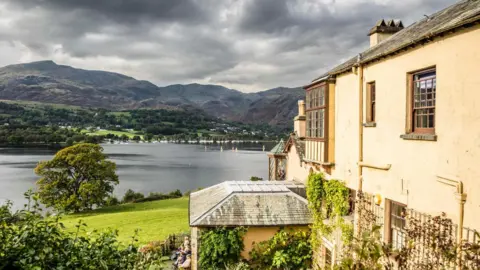
Picturesque Coniston, in England's Lake District, is arguably as famous for the exploits of speed king Donald Campbell as it is for its rolling hills. Almost 60 years on from his death, how do local people feel about Campbell and his legacy?
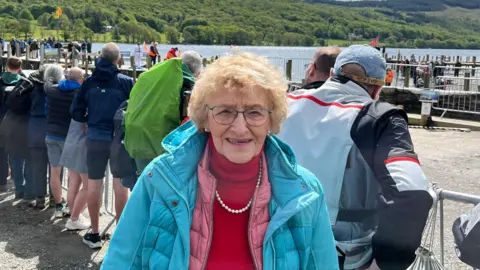
"He was just one of us. There were no airs and graces," says Anne Hall, as she remembers the man who set eight world records on land and water.
"I don't think I can put into words what people felt after the accident."
That fatal crash, on Coniston Water one cold January morning in 1967, came as the 45-year-old Englishman pushed to extend his world speed record past 300mph (480km/h) in hydroplane Bluebird.
"I remember the fateful day - with reporters coming in, pleading to use my telephone because there were so few in the village," continues Hall, a former parish and district councillor who has lived in the area for all of her 83 years.
"His story has captivated people from all over. It's a pull in so many ways."
Fellow resident Dorothy Coxon agrees.
With her husband Keith, she moved to Coniston in the September - eight months after the smash that had made headlines across the globe.
"When we first came here, that's all anybody talked about - the Campbell accident," she recalls.
"There was a reverance - almost a worship - of what he'd done and how important it was to Coniston."
 Getty Images
But the Campbell family links to the village did not start with Donald.
His father, Sir Malcolm, first ventured to the area for record-breaking purposes in 1939, having set three water-speed records in Switzerland in 1937 and '38.
"As time went on, there was the realisation there could be a war and [Sir Malcolm] Campbell didn't want to be caught in Europe with all his equipment for his boat," explains author Neil Sheppard.
"He considered Britain and looked at Loch Lomond, but thought it was too big a body of water, and also Loch Ness, but realised it was too long and deep.
"And so he put an advert in a newspaper for a lake in Great Britain, five-miles long, for high-speed water record trials, and was put in touch with Coniston.
"He visited here in the early summer of 1939 and thought it would be perfect."
A record of 141mpm (227km/h) followed in August, with war declared just weeks later.
Sir Malcolm died in 1948 with no thoughts at that point of his son following in his footsteps, according to Sheppard, who penned Donald Campbell, Bluebird and the Final Record Attempt.
However, soon after, "Donald was told of an American attempt to break his father's record and he decided I want to keep it in the family".
From 1949 onwards, Donald would be a regular visitor to Coniston.
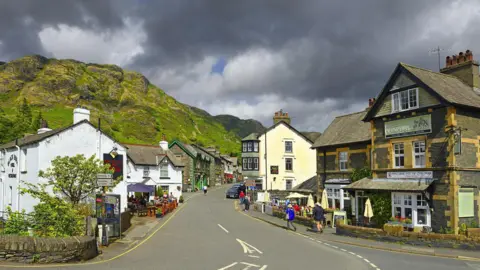
Staying in the village, he and his support team would base themselves at the Black Bull Inn, and later at The Sun.
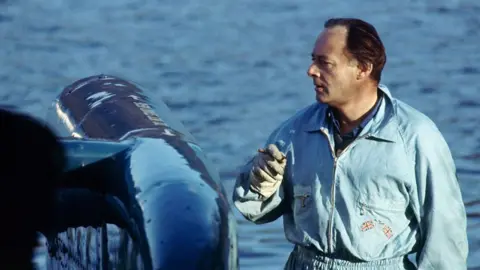
Donald set four records at Coniston, before his untimely death on 4 January 1967 which saw the 12-year-old Bluebird tip over backwards and somersault, before sinking into the icy lake.
Interest levels in his story have ebbed and flowed in the decades that followed.
By the turn of the millennium, "the life and achievements of Donald Campbell were a relatively niche interest," Sheppard says.
Curiosity was renewed when Bluebird, and later its skipper's remains, were lifted from the lake bed in 2001 by Tyneside diver and engineer Bill Smith, who went on to lead the boat's rebuild.
"Bill lifting the boat was a tangible sight, but I think it also coincided with the emergence of the internet, so a lot of people realised there were others like them out there," Sheppard argues.
Bluebird has been on display in the village's Ruskin Museum - named after Victorian writer and artist John Ruskin - for the past two years following the settlement of an ownership row between the organisation and Smith.
More than 60,000 people visited the museum over the 12 months following Bluebird's arrival, a significant swell on the usual 10,000.
 Getty Images
Julie Ward, a customer service advisor at Coniston Information Centre, says there has been a significant uptick in interest since the boat went on display at the museum.
"There's always been interest. Now we get asked every day."
On Monday, Bluebird returned to action on Coniston Water for the first time since Donald's death, as spectators lined the shore alongside his daughter, Gina, and nephew, Don Wales.
It was the first day of a week-long Bluebird event, with organisers hoping the hydroplane could run at speeds up to 150mph.
Some villagers, though, had concerns, says Ward, who also moved to the area in 1967, running a newsagents locally until six years ago.
Those worries mainly centred around £25 parking charges and potential traffic levels, with the Lake District National Park Authority having at one point estimated up to 20,000 people could descend on the village daily.
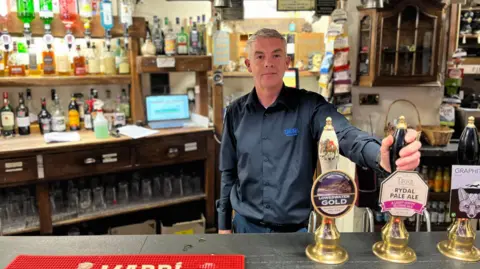
"People have been quite sceptical. A lot of signage went up and one-way systems etc," says John Cook, current manager of The Sun.
"But the majority of people think it's brilliant for the village. Coniston always been on the map, but it's seriously on now.
"All our rooms have been fully booked."
Interest in Campbell is once again at a heightened level, but will the connection persist?
"Anybody interested in speed and water is drawn to the Campbell story, inevitably, and what it meant to Coniston," Dorothy Coxon says.
"So I don't think that legacy is going to go away.
"I think it will stay part of the Coniston legacy for a long time and events like this week will aid that."
