Families question use of do-not-resuscitate orders

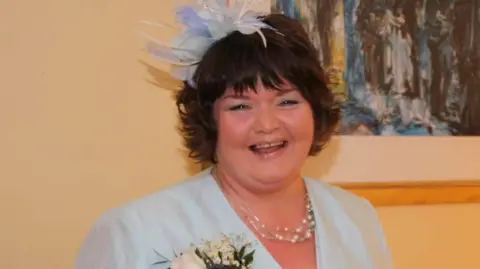 McKinney Family
The families of two women who died in Northern Health trust hospitals more than four years ago have questioned how do-not-resuscitate decisions were made during the Covid-19 pandemic.
Both families said they only learned Do Not Attempt Cardiopulmonary Resuscitation (DNACPR) orders were in place, after the women had died.
Figures obtained by BBC News NI show a total of 28 official complaints involving DNACPR decisions were made to health trusts in Northern Ireland between March 2020 and December 2021.
The Northern Trust, which received 17 complaints, said it recognised some families had raised concerns about care and apologised "for any further hurt that they may have experienced".
Alison McKinney from Coleraine died in August 2021 while a patient at the Causeway Hospital.
She was 56 when she was admitted to the hospital with Covid-related pneumonia that same month.
Despite being treated in the hospital's intensive care unit, her daughter Lizzie Lyle said she expected her mother, who also had diabetes, to make a full recovery.
She told BBC News NI that her mum died with Covid pneumonia, but it was only when the family requested her medical notes that they realised a DNACPR was in place.
She added that her mum, who had a "love for life" and was "scared of dying", would not have consented to one.
Nor, she said, were her family consulted about one.
"One of the pages said on it, DNR with 'not yet discussed' circled.
"And I was like, what does that mean? And I was angry, I was shocked."
 Lizzie Lyle
What is a DNACPR order?
A DNACPR order means a decision has been made to not resuscitate a patient if their heart or breathing stops.
Under NHS guidance, a DNACPR order can be added to someone's medical notes. This would normally be after consultation with the patient or their family members.
It means medical staff will not attempt chest compressions or defibrillation - where an electric shock is applied to restore normal heart rhythm - if the patient's heart or breathing stops.
The McKinney and McGrath families do not believe resuscitation attempts were made because of the DNACPR orders in their medical notes.
Mum 'was horrified' when she found out what a DNACPR was
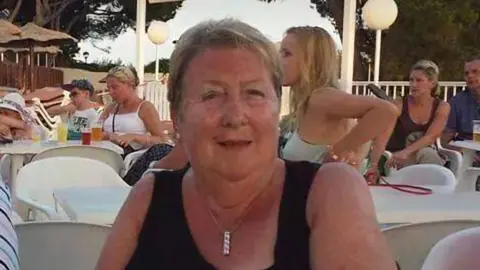 McGrath Family
June McGrath, who was 75 and from Newtownabbey, died in Antrim Area Hospital in November 2020.
Her daughter, Jennifer Currie, said her mother was being treated for an ulcerated leg and died with pneumonia after contracting Covid-19.
Mrs Currie remembered her mum contacted the family from hospital and said she had been asked about a DNACPR.
"She phoned and said: 'These doctors have been around and they're asking me, do I want to sign a DNACPR?'
"My mum didn't really know what it was. So, she asked us and she was horrified."
After her death, the family found a DNACPR document, seen by BBC NI, in her medical notes.
"It also states in it that it was discussed with the family," she added.
"They did not discuss that with us and I know for a fact my mum would never have agreed to that."
Trust 'very sorry to hear' of families' concerns
 McGrath Family
The Northern Trust offered its condolences to the McKinney and McGrath families.
"We always strive to provide the highest standards of compassionate care and we are very sorry to hear that the families have concerns about the care we provided," said a trust spokesperson.
They said the experience of patients and families was hugely important and that the trust was committed to ensuring learnings were identified and action taken.
No blanket 'do-not-resuscitate' orders in place
Figures obtained by BBC News NI show that between March 2020 and December 2021 the Northern Trust received 17 complaints where a DNACPR is an aspect of the complaint.
The Belfast Trust received 10 complaints and the Western Trust one.
No complaints were made to the Southern or South Eastern trusts.
Neither the McKinney or Currie families have made an official complaint.
They told BBC News NI they were still grieving their loss and had no confidence in the Northern Trust.
In November 2024, former health minister Robin Swann told the UK Covid Inquiry that there was not a blanket "do-not-resuscitate" order in place for sick patients in Northern Ireland during the pandemic.
A spokesperson for the Department of Health (DoH) said clinical decision making during the pandemic was supported by the Regional Covid-19 Ethical Advice and Support Framework for Northern Ireland.
"Decisions and recommendations in relation to cardiopulmonary resuscitation (CPR) must be individual to each person and follow the relevant professional and legal frameworks," the department spokesperson said.
The DoH said the minister "acknowledges that some of these decisions and recommendations were deeply distressing for family members".
Who has the power to make 'do-not-resuscitate' orders?
In a statement, the Northern Trust said it acknowledged how important end of life care was.
It said responsibility for DNACPR decision making rests with the clinicians in charge, adding patients should be involved in discussions around resuscitation.
"If a competent adult decides to refuse CPR then that decision must be respected," the trust said.
It added that if the patient was unable to make the decision, one should be made using a multi-disciplinary team approach" which requires the "views of any relevant others" to be taken into account.
The trust added: "In circumstances in which it is not possible or appropriate to discuss cardiopulmonary resuscitation with a patient and/or their relevant others, the DNACPR form must still be completed indicating the reasons why these discussions were not appropriate."
Speaking to BBC Radio Foyle's North West Today on Friday, the DUP MP for East Londonderry Gregory Campbell called on the Health Minister Mike Nesbitt to order an independent investigation into what happened.
He described the experiences of Alison McKinney and June McGrath's family as "harrowing".
"I think we are at the point now where an investigation has to be held, given the number of people affected by this," Campbell said.
"There does need to be an independent investigation into this, and it needs to be done urgently.
"We need to get to the bottom of this now in preparation for any future pandemic of any kind; we know exactly what the circumstances are [relating to DNACPR].
In response the DoH said: "The Covid-19 pandemic brought unprecedented and deeply sensitive challenges for our health service, government, for many families and society as a whole.
"It is clearly vitally important that lessons are learned in order to inform any measure which may be considered in the event of a future pandemic."
