'We turned our worst time into something positive'

 BBC
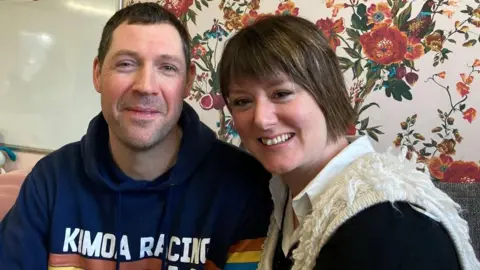
BBCA mum who experienced a perinatal mental health crisis has set up a support group for parents, as part of a campaign for better knowledge and care for new families.
Stef Scurr, from Thirsk, found herself "spiralling very quickly" after the birth of her first child but said she struggled to understand what was happening to her, or to know where to get help.
After a stay in hospital, she and her husband Andrew Dunn set up Brighter Skies to turn "the worst time of our lives into something positive", she explained.
A NHS England spokesperson said its perinatal and maternal mental health services supported women across "every part of England" facing a "wide range of complex mental health needs".
Scurr, 35, said that her story "shows how quickly things can change", as shortly after giving birth to her son, she started to suspect something was wrong.
In the following weeks, she experienced anxiety and low moods, which left her feeling stuck and helpless, she said, unable to concentrate or make decisions.
"I kept thinking something would click back into place, but I knew in my core that something was just not quite right," she said.
"In terms of our journey and my illness, it just spiralled really quickly.
"It doesn't happen like that for everybody, but it shows how quickly things can change."
The family reached a turning point when Scurr and her son moved into a mother and baby unit, a mental health ward, after she attempted to take her own life.
Describing staff on the ward as "absolutely brilliant", she stayed as an inpatient for six weeks, receiving treatment and recovering from severe postnatal depression.
According to the NHS, one in 10 parents can experience both antenatal and postnatal depression.
Postpartum psychosis is rarer, affecting one in 1,000 women, but is considered a serious mental health condition that should be treated as a medical emergency.
- If you are affected by any of the issues raised in this story, support and advice is available via BBC Action Line.
Scurr said she had not experienced poor mental health before but "in some ways, that made it so much more scary" because she had "no idea" what was happening.
She and Dunn feel that if they had had a group similar to Brighter Skies while expecting, it could have been easier to understand signs of a mental health crisis, and be signposted to the right services.
"I could have come to the group during my pregnancy, met other people and built up a rapport," Scurr said.
"Then when I'd had my baby, we could have come back and gone 'we need some access, we need some advice'.
Dunn added: "It was a very dark time and if we'd had support, it might not have gotten so dark.
"It's trying to get help at the bottom of the ladder before anybody gets to the top and it's too far."
According to NHS England, 66,370 new and expectant mums in England accessed its specialist perinatal and maternal community mental health services, a 117% increase since March 2020.
A spokesperson for the public healthcare body said they "expect local investment to be protected and recent progress to be built on this going forward".
"Having a baby is a very special time, but it can also bring significant challenges," they said.
"That's why our specialist perinatal community mental health teams and maternal mental health services - now in every part of England - are dedicated to supporting women facing a wide range of moderate to severe or complex mental health needs including birth trauma and severe depression."
'Spot the signs'
Last month, Brighter Skies hosted its first drop-in session at Thirsk Community Primary School, in collaboration with local charity Community Works.
Avril Scurr, Stef's mother, was present to support her daughter.
"I'm so proud of her, from what she's been through, to turn it all round to help others so they don't have to go through that, is absolutely brilliant," she said.
"I was glad when Steffy did go into hospital because as I know now, if she hadn't we wouldn't have Steffy."
Lucy Hoyle, mum to a three-year-old, came along to show her support.
"After those first couple of weeks, into those next couple of months, it's such a blur and nobody can tell you how to do it, nobody can tell you what's right or wrong," she said.
"But you have an innate sense of how you feel and if that ever drifts too far away from what you feel is right for you, then seek help."
She added gaining a deeper understanding of postpartum mental health, particularly around postpartum psychosis, was crucial.
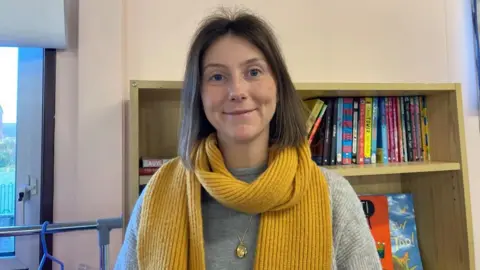
"I think everyone knows about postpartum depression and the 'baby blues' but in terms of psychosis specifically, it is a different kettle of fish, a different scenario.
"So I think this sort of space is important because people need to understand the risk, how to spot the signs, and know where they can go for help."
Also attending the session was Charlie Wilson, who came with her 15-month-old son.
She has anxiety, and so coming somewhere with her baby could often be "really hard", she explained.
"I think people don't realise how hard and lonely motherhood can be," she said.
"We're all in the same boat [but] we shut ourselves off and isolate ourselves, and places like this bring people out of their shell."
She added that she had met people who had been in exactly the same position as her, and found that "everyone feels comfortable to talk to everybody else".
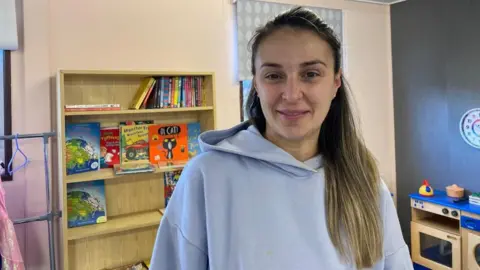
Ilia Pascu, who has two young children, said having a community around her to offer support was important.
"Even with my second child, it's amazing to have a bit of support and find people like Stef and her husband to help parents.
"It's not just about mums, dads need help as well, they can struggle with the new baby and new life, so it's definitely good to share experiences and stories."
Scurr said in the future she hoped that they could roll out further provision across North Yorkshire, and host experts to hold talks.
She described being a parent as "amazing" but "one of the hardest and most fragile times you can go through".
"We want to give someone else hope that if you're ever feeling like that, things do get better," she added.
"We want to hold that hope and light for other people."
Listen to highlights from North Yorkshire on BBC Sounds, catch up with the latest episode of Look North.
