Roman mosaic returns home after 200 years

 Trustees of the British Museum
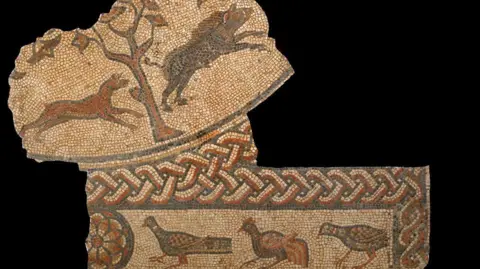
Rare fragments of a Roman mosaic are being reunited for the first time since they were unearthed, more than 200 years ago.
The mosaics, which included a depiction of Orpheus charming animals and birds with his music, were discovered in a Roman villa near the village of Withington in Gloucestershire in 1811.
Held in storage at the British Museum for centuries, three fragments showing a bear, a leopard and a boar are now on display at Corinium Museum in Cirencester.
Emma Stuart, the museum's director, said: "I am thrilled. Apart from the very, very brief airings - they've not been seen by the public in the 200 years since they've left the county."
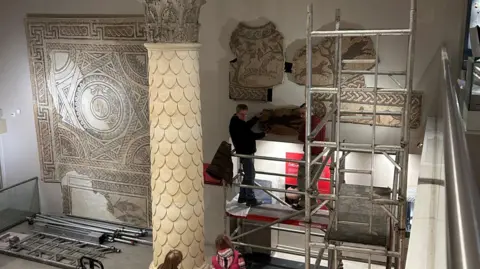
The Withington fragments are to go on display alongside the Orpheus Mosaic which was discovered 10 miles (16km) away from Withington at Barton Farm in Cirencester.
The largest of the fragments, which depicts a wild boar being chased by a hunting dog, measures about 2.5m (8ft) across, while the smallest bear fragment is about 1m (3.2ft) long.
Stuart said several Withington fragments were sent to London by the landowner after they were discovered, while a single section was "gifted to Bristol Museums".
"The fact that these have survived for at least 1,800 [years] if not longer, is incredible.
"To have the [fragments] on display here at the Corinium Museum has been on my wish list for a long time. I am thrilled and I can't wait for people to see them," she added.
 Corinium Museum
Richard Hobbs, from the British Museum, said surprisingly, very few mosaics from Roman Britain are available for public view in British museums.
"The vast majority of mosaics have either been lost, damaged beyond recovery or still lie buried under the soil.
"We therefore have to be grateful to our antiquarian ancestors for preserving these fragments for future generations," he said.
Follow BBC Gloucestershire on Facebook, X and Instagram. Send your story ideas to us on email or via WhatsApp on 0800 313 4630.
