I bring joy and movement to dementia care

 Jules Jenkinson
A woman who uses music and rhythm to help people with dementia regain essential life skills has been celebrated for her work.
Jules Jenkinson visits care homes in Hampshire and Dorset to deliver Love to Move - chair-based exercise sessions that use coordinated movement to stimulate the brain.
She has won an award from the British Gymnastics Foundation (BGF), which said her "extraordinary" work had a "profound and lasting impact on the lives of residents".
Love to Move was developed in the UK after chair-based exercise schemes in Japan and South Korea showed striking results.
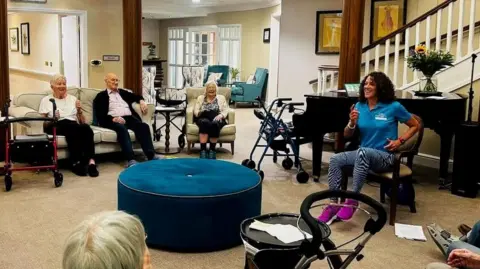 Jules Jenkinson
Jenkinson said it was "hugely rewarding" to see people experiencing memory and cognitive decline come together to improve their confidence and mobility.
"Some residents say it's the highlight of their week," she said.
"We bring a lot of fun and joy and they learn things too.
"And care home staff tell us the programme is helping people regain everyday skills like dressing themselves and using a knife and fork."
Love to Move encourages people to use both sides of their body simultaneously in a system known as bilateral asymmetrical movement.
This stimulates the pathways between neurons in the brain and helps people with memory and other cognitive functions.
"We call it brain gymnastics," Jenkinson continued.
"We use symmetry and asymmetry throughout the programme, getting people to use their right and their left hand, for example.
"We do a bit of memory recall and multitasking. The music helps with coordination and it's really uplifting."
Early UK pilot work involving more than 150 participants found improvements in physical ability, social interaction and mood, with Age UK describing "demonstrable benefits in the physical, emotional and cognitive aspects of older people".
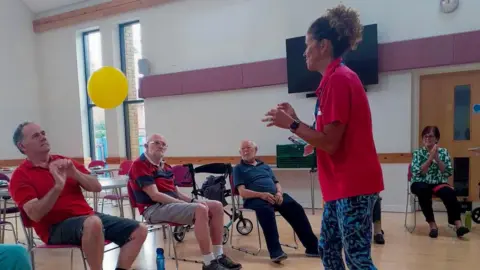 Jules Jenkinson
BGF said Jenkinson's "dedication, warmth, and energy" had transformed the experience of residents.
They added that she had helped residents feel "included and valued" regardless of ability or confidence - helping those who rarely engage and connect with those around them.
The award is named in memory of Hazel Green, one of the first participants in the Love to Move programme, whose experience highlighted the potential for exercise to improve quality of life for people living with dementia.
You can follow BBC Hampshire & Isle of Wight on Facebook, X, or Instagram.
