Canada unveils auto industry plan in latest pivot away from US

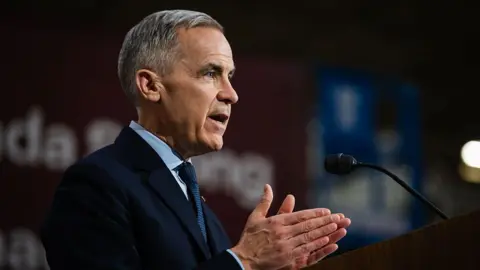 Bloomberg via Getty Images
Prime Minister Mark Carney has unveiled a plan to bolster Canada's car industry and support its electric vehicle transition, as the sector buckles under the weight of US tariffs.
The new initiatives, announced on Thursday, mark Canada's latest effort to reduce its reliance on the US, amid President Donald Trump's push for more domestic car production.
Carney's strategy includes financial incentives for carmakers to invest in Canada and the reintroduction of rebates for EVs.
Trump last year imposed a 25% tariff on Canadian cars and car parts. The levies were a shock to car production in Canada, where roughly 90% of vehicles are exported to the US.
Many US car companies have operations in Canada, set up under the terms of a longstanding free trade agreement, and supply chains are highly integrated.
The United States-Canada-Mexico (USMCA) free trade agreement is up for review this year. But the agreement's original purpose, of removing tariffs across North America, was no longer the current objective of the US administration, Carney said at a car plant in Toronto on Thursday. "Their approach has changed."
"We have to prepare for all possibilities," he added.
Thousands of Canadian auto workers have lost their jobs since Trump returned to the White House, as major carmakers including General Motors and Stellantis have scaled back their production in Canada.
Among Carney's initiatives unveiled on Thursday is a new tariff scheme offering credits to car companies like General Motors and Toyota that produce vehicles in Canada, to help offset tariff costs.
Canadian officials, faced with upheaval in their trading relationship with the US, have in recent weeks looked to other countries in a bid to boost the Canadian auto sector and reduce its ties to the US.
Carney's announcement on Thursday follows a deal with China last month that will see Canada ease tariffs on Chinese electric vehicles that it imposed in tandem with the US in 2024.
Canada also unveiled an agreement with South Korea last month that is set to encourage Korean car manufacturing in the country. Both agreements could undercut US car firms.
Carney said on Thursday that Canada will reintroduce EV buyer incentives - a move that stands in contrast to the US, where Trump last year ended a government subsidy that had helped lower the price of certain battery electric, plug-in hybrid or fuel cell vehicles.
Officials will also enact stronger emissions standards for new vehicles, with a goal of EVs comprising 90% of car sales by 2040.
But at the same time, Carney scrapped an electric vehicle sales mandate introduced by former Prime Minister Justin Trudeau in 2023, which had elicited backlash from automakers who had argued the policy was too costly.
Pivoting to a tougher emissions standard for vehicles "focuses on the results that matter to Canadians, while avoiding undue burdens on the Canadian auto industry", Carney told reporters.
Some environmental groups swiftly voiced opposition to the shift away from the EV sales mandate that Trudeau had championed.
