Delays detecting fire 'led to prisoner's death'

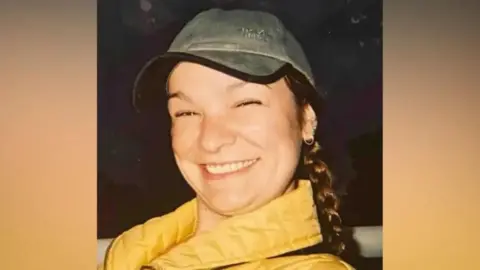 Family handout
A prisoner died due to delays in detecting a fire she caused in her cell after there were "missed opportunities" to give her better mental health care, an inquest has found.
Clare Dupree, 48, from Cardiff, died of smoke inhalation on 28 December 2022, two days after a vape caused a fire in her cell at HMP Eastwood Park, near Bristol.
A jury at Avon Coroner's Court delivered a critical verdict, which said it was a failure not to hospitalise Dupree before she returned to prison.
It also concluded the lack of in-cell automatic fire detection (AFD) "possibly contributed" to Dupree's death.
This prompted the coroner to submit a prevention of future deaths report raising concerns about the lack of AFDs in prisons.
In statements to the inquest, Dupree, who had six children, was described by her family as a "delightful and sensitive" person who had a long history of mental health problems.
The inquest heard that on Boxing Day 2022, Dupree was removed from her cell by the fire service 33 minutes after the fire was detected. Her cell door had been too hot for prison staff to enter.
Not only did the lack of AFD cause a delay in alerting staff to the fire, the jury found, but multiple failures to follow processes led to delays in alerting the fire service.
It was agreed in 2015 that Eastwood Park would have AFDs installed, and would until then have to rely on domestic fire detectors outside cells. The installation is not expected to be completed until 2028.
In conclusion, the jury said on Tuesday: "Clare died from sustained inhalation of smoke due to a delay in detection of fire as a result of arson."
They also found it was a failure Dupree was not hospitalised in August 2022 when she was experiencing psychosis and was released into the community with nowhere to live.
This was "a missed opportunity to ensure she received the appropriate care and support to reduce re-offending", the jury said.
They agreed with the view of an expert witness, consultant forensic psychiatrist Dr Inti Qurashi, that Dupree had been misdiagnosed as having a personality disorder, which contributed to her returning to prison.
After she returned in November, the jury said her mental health care was adequate, but the delay in the assessing whether she should be sent to a psychiatric intensive care unit "possibly contributed to Clare's death as a timely assessment would have resulted in hospitalisation and appropriate care".
'Simply not good enough'
Clare Hayes and Betty McCann from law firm Deighton Pierce Glynn, who represented Dupree's family, said: "Women's prisons are not safe spaces and prison was not the right place for Clare.
"Her family have had to endure harrowing evidence that Clare's pathway back to prison could have been avoided had she received the wraparound mental health care and support that she desperately needed."
They added that it was "simply not good enough" that more than three years after her death work would begin to put AFDs into all cells at HMP Eastwood Park.
"Fire safety in prisons needs to be a priority for the Prison Service to prevent any more tragic deaths," the solicitors said.
A Prison Service spokesperson said: "Our thoughts remain with the friends and family of Clare Dupree following her tragic death."
They added that recommendations from the prison ombudsman had been acted on, and that the service takes safety "extremely seriously", despite fire-related deaths in prison being "very rare".
Follow BBC Bristol on Facebook, X and Instagram. Send your story ideas to us on email or via WhatsApp on 0800 313 4630.
