How does an NHS trust reduce waiting lists?

 ELLEN KNIGHT/BBC
Big improvements in patient waiting time have been made by an NHS trust that runs two acute hospitals in Shropshire.
New figures show waiting lists for planned surgery at Shrewsbury and Telford Hospitals NHS Trust (Sath) have fallen, with 65.5% of patients waiting fewer than 18 weeks for treatment in November 2025, compared to 48.5% a year earlier.
It means six in 10 patients are now undergoing elective or planned surgery - those non-emergency procedures like gallbladder removal - within the 18-week target.
But how did they do it? And can other trusts learn from their example?
The trust credits a big chunk of its success to a £24m, purpose-built elective surgery hub, which opened at Telford hospital in 2024.
Over the past year, surgical teams say they have performed more than 8,000 elective procedures there.
'Rewarding to see patients do well'
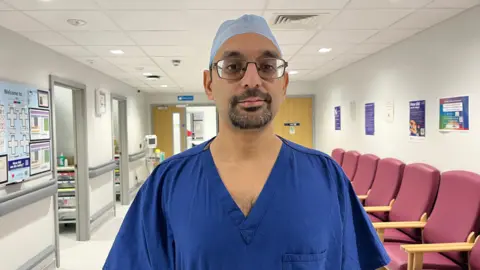
Saurav Chakravartty, a consultant who specialises in gastrointestinal and bariatric, or weight loss surgery, says the hub has opened up new opportunities.
"We've been able to do more cases - without being impacted by emergency care," he said.
Chakravartty explained that by focusing purely on planned care, "the trolleys here are not being taken up by emergency patients," resulting in fewer surgery cancellations.
"Overall, the operating numbers have gone up," he said, and the efficiency of the process has "contributed to a good working culture" for staff at the hub.
"It is rewarding to see patients do well."
 ELLEN KNIGHT/BBC
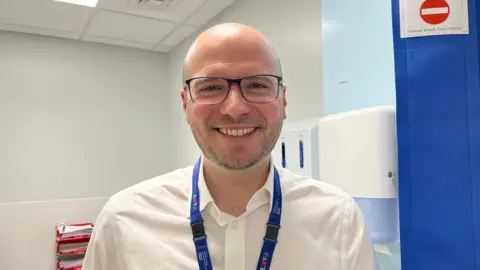
But there is "no silver bullet," according to Ned Hobbs, chief operating officer.
The three biggest changes the trust has implemented are "improvements to outpatient services, our operating theatres, and our diagnostics," he said.
Hobbs added that in outpatient departments, staff were "seeing more patients per clinic".
In operating theatres, there has been a conscious effort to make sure "every theatre is running every day of the week."
"That means we're now typically operating on about 1,600 patients a month, compared to around 1,200 patients per month previously," Hobbs added.
 LDRS
LDRSAnd whilst there was no secret he could pass on to other trusts, Hobbs acknowledged that it was "the cumulative effect of lots of improvements in lots of parts of the elective pathway".
"What we've seen is the terrific skills and potential of our staff to deliver improvements that ultimately benefit patients - we've got plenty more still to do."
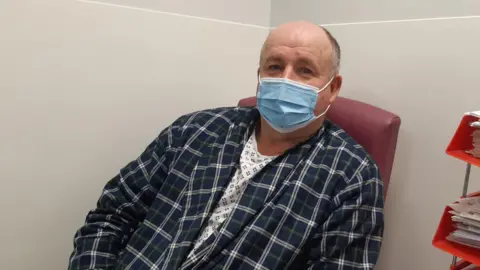
Melvin Jones, 56, a farmer from Llanfair Caereinion, a market town in mid-Wales about an hour's drive west of Telford, underwent keyhole surgery on his gallbladder, at the Princess Royal last month.
'Wrong side of border'
"They were very efficient to be honest, and fair play to the staff - I can't complain at all," he said.
Jones added the process "moved extremely fast", going from a scan on 9 December to 12 January, when the procedure was carried out.
"I went in at half past seven in the morning, and I was home by six o'clock in the evening," he said.
Jones added that he was particularly impressed since, as he says, he "lives on the wrong side of the border".
"People here in Powys can sometimes be waiting a very long time," he added.
Follow BBC Shropshire on BBC Sounds, Facebook, X and Instagram.
