Council calls on government to reject CO2 pipeline

 Peak Cluster
Leaders at Derbyshire County Council have urged the government to reject a major multi-million-pound decarbonisation project in the Peak District.
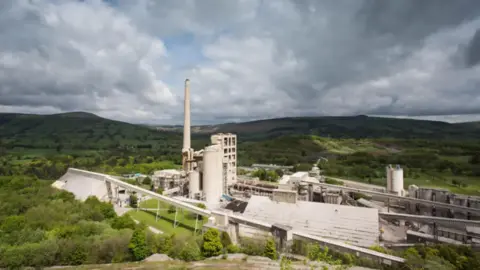
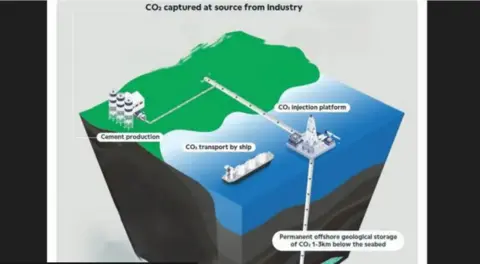
The proposed Peak Cluster project would capture harmful carbon dioxide (CO2) from three cement and lime plants and transfer it by pipeline to a storage facility under the Irish Sea.
But the county's Reform UK leaders formally marked their opposition to the scheme via a motion at a full council meeting, citing environmental and safety concerns.
Peak Cluster said it was keen to work with councillors "wherever possible" to address any potential local impacts.
At the meeting, councillors heard claims that the Peak Cluster pipeline would cut through towns, farms and environmentally sensitive areas, carrying pressurised CO2 from cement works in the Hope Valley and near Buxton.
It is expected that the application for the scheme will be submitted for government approval in 2027.
The motion - put forward by independent Whaley Bridge councillor and former Labour MP Ruth George - claimed a full safety framework for CO2 pipelines in hilly terrain would not be ready until 2028, making it impossible for the council to guarantee public safety or plan emergency responses.
It called on the authority to write to government ministers setting out concerns, and to back investment in lower‑carbon cement technologies instead of long‑distance CO2 transport.
Campaigners have said they want to stop the plans because they are worried about the damage that will be done when the pipe is built between the Peak District and the north west coast.
Neighbouring authorities have also voiced concerns about the project.
The majority of opposition councillors agreed with the concerns.
The council's leader Alan Graves told the meeting the project asks residents "to bear enormous costs and risks".
"We are being asked to accept a major infrastructure project before the rules on safety are fully understood," he said.
"We know there are alternatives...proven innovations already delivering major [carbon] reductions.
"This is what it comes down to: real risk to safety, permanent damage to the countryside, major disruption to communities, enormous cost to taxpayers.
"All for a project where the burden falls locally and the justification is national. That imbalance matters."
The meeting heard that Reform UK's central leadership had given assurances to the Derbyshire group that they would cancel the scheme if they got into government.
 Carbon Capture and Storage Association (CCSA)
The motion described the project as "posing serious potential risks to life in the event of a serious release" of carbon dioxide.
"Local cement producers have advised that the scheme is essential to maintaining competitiveness and serves the national interest, and that land affected during construction would be restored with minimal visible impact," it notes.
"However, council recognises that the pipeline would cross communities, farmland and environmentally sensitive areas that are central to our county's identity, economy and natural heritage.
"Carbon dioxide is colourless and odourless and can displace oxygen, posing serious potential risks to life in the event of a serious release. Safety measures must therefore be robust, transparent and independently verified."
Peak Cluster was contacted for comment.
David Parkin, chair of Peak Cluster, said: "We understand that Derbyshire County Council has strong views about Peak Cluster.
"That is why we are keen to continue to work with them, and their councillors, as those that know the area best.
"This will help us gain as much information as possible as we develop our plans for the project and design Peak Cluster in a way that anticipates, understands and addresses potential local impacts, wherever possible."
Listen to BBC Radio Derby on Sounds and follow BBC Derby on Facebook, on X, or on Instagram. Send your story ideas to eastmidsnews@bbc.co.uk or via WhatsApp on 0808 100 2210.
