Peak District carbon capture plans hit opposition

 Supplied
Residents are campaigning against plans for a major £28.6m de-carbonisation project in the Peak District.
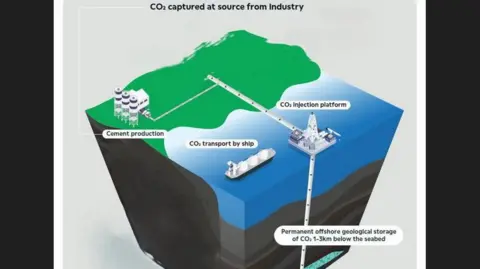
The proposed Peak Cluster project will capture harmful carbon dioxide from three cement and lime plants and transfer it by pipeline to a storage facility under the Irish Sea.
Campaigners have said they want to stop the plans because they are worried about the damage that will be done when the pipe is built between the Peak District and the north west coast.
But Peak Cluster has said it will work with experts to minimise the environmental impact and when operational, the project will prevent three million tonnes of carbon dioxide going into the atmosphere every year.
 Carbon Capture and Storage Association (CCSA)
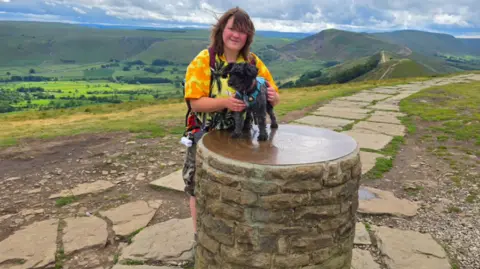
Laura Stark, from Castleton in Derbyshire, said she was worried the project would spoil the look of the area.
She said: "This will affect millions of visitors to the Peak District every year.
"Why would they want to come to a place that is a construction site? This will take years.
"You have people living in industrialised areas and this is their safe place - this is their haven away from that.
"This project will industrialise the countryside and ruin it for everyone."
The Peak Cluster will focus on three sites Tunstead Quarry, near Buxton, Hope in Derbyshire and Cauldon in Staffordshire.
The sites produce up to 40% of the UK's cement and lime.
Cement is used to effectively glue concrete in the building industry and lime is used to make steel, glass and agricultural goods.
But carbon dioxide is released during manufacturing, so the idea is to capture it at source and transfer it to an empty gas reservoir under the Irish Sea where it can be safely stored.
The transfer pipe will run through Derbyshire and Cheshire to the Wirral where it will then go under the sea.
 Supplied
Laura Beveridge-Muircroft, from the Wirral, part of Action Against Carbon Capture and Storage (CCS), said she believed as this was new technology, there were no guarantees it would work as planned.
"What we want is for the government to scrutinise what they're saying they want to do for net-zero.
"There is really good technology out there that will actually capture carbon at source and re-use it as energy. We want the government to explore those options.
"So it is not a case of do nothing. We are saying do something. Just don't rush into things that we don't know what the consequences are going to be," she said.
'Significant visual impact'
David Parkin, chair of Peak Cluster, said the pipeline was the only way to store this amount of carbon dioxide.
He said the amount of carbon captured would be the equivalent to that emitted by all the homes in Liverpool for five years.
"The carbon store beneath the East Irish Sea has the capacity to safely hold around one billion tonnes of CO2," he said.
"This would mean it would be able to store the carbon dioxide emissions from the Peak Cluster's cement and lime plants for around 330 years before it is full."
During the construction phase of the pipe, Parkin said the project would be taking independent advice from Natural England and the Environment Agency.
"Once the pipeline is installed, the land above it would be put back just as it was before," Parkin added.
"We're also committed to working with local groups and stakeholders to boost biodiversity across the whole project area, leaving habitats for wildlife in a better state than before construction began."
In a statement, the Peak District National Park Authority said that as this was a scheme of national importance, the government would be ruling on it rather national park planners.
The authority said: "A scheme of this size is likely to have a significant visual impact at the processing sites where equipment will be installed.
"This would be for the lifetime of the installation and not a permanent change to the landscape."
Follow BBC Derby on Facebook, on X, or on Instagram. Send your story ideas to eastmidsnews@bbc.co.uk or via WhatsApp on 0808 100 2210.
