Lockerbie bomb suspect appears in US court over confession claim

 Reuters
A Libyan man accused of building the device used in the Lockerbie bombing has appeared in a US court as his lawyers attempt to stop his alleged confession being used as evidence at his trial.
The US Department of Justice claims Abu Agila Mohammed Mas'ud Kheir Al-Marimi, referred to as Masud, admitted taking part in the attack on Pan Am Flight 103 when questioned at a Libyan detention facility in 2012.
However, Masud has claimed the confession is false, was made under duress and should be ruled inadmissible before his trial in Washington DC later this year.
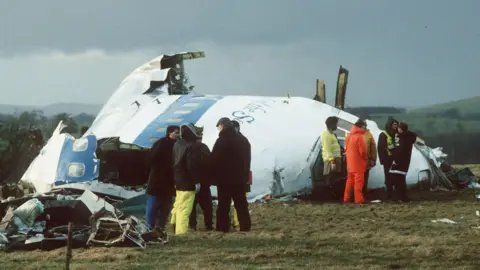
He has denied making the bomb which destroyed the American aircraft over the Scottish town on 21 December 1988, killing 270 people.
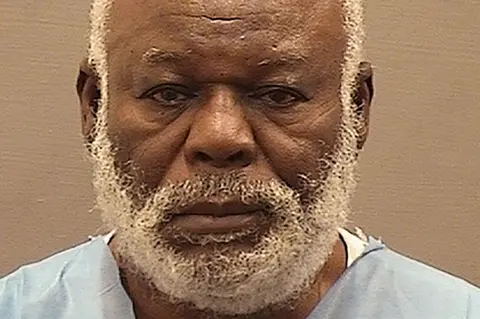
Wearing a washed-out prison uniform and sporting a short grey beard, Masud listened as the hearing before judge Dabney L. Friedrich got under way at the District Court for the District of Columbia on Wednesday.
Relatives of the victims were also present, along with representatives of Scottish law enforcement, who have been partners in the investigation with their American counterparts.
Remote viewing facilities were set up in three locations in the United States and one in the UK to allow other people connected to the case to watch the proceedings unfold.
Details of Masud's alleged confession were first made public when the FBI criminal complaint against him was published in 2020.
It is claimed Masud admitted bombing the LaBelle Discotheque in West Berlin in 1986, killing three people, including two American servicemen.
He is also said to have further confessed to taking a bomb hidden in a suitcase from Libya to Malta in December 1988, under the orders of senior officials from the Libyan intelligence service.
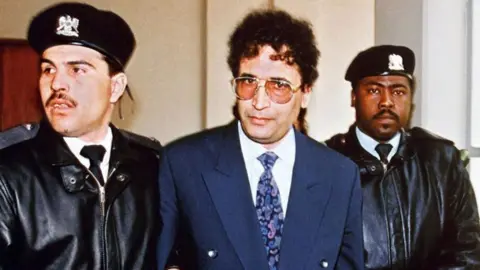
There, he is alleged to have met two accomplices - Abdulbasset Al Megrahi, the Libyan agent convicted of bombing the plane after standing trial 25 years ago, and Al Amin Khalifa Fhimah, a former Libyan Arab Airline official who was cleared by the same Scottish court.
According to the confession, Masud set the bomb timer so the explosion would occur exactly 11 hours later, bought clothes to pack into the brown Samsonsite suitcase that held the device, and then handed it to Fhimah at Luqa airport on Malta the next morning.
Fhimah was said to have placed it onto a conveyor belt, introducing the unaccompanied bag into the international baggage system, tagged to be flown to the US.
 Reuters
It exploded that night in the forward hold of Pan Am 103 as it flew from Heathrow to New York, killing all 259 people on board and 11 residents of Lockerbie when the wreckage fell on their homes.
Masud is alleged to have claimed that he was later congratulated in person by the late Libyan dictator Colonel Gaddafi, for carrying out "a great national duty" against the Americans.
In court documents lodged before the hearing, Masud claimed he had been forced into making a false confession by three masked men who had threatened him and his family.
In response, the US government said Masud had freely provided a highly detailed insider account corroborated by other evidence from the case.
 AFP via Getty Images
At the start of the hearing on Wednesday, FBI special agent Todd Tunstall told the court the alleged confession was originally obtained by Scottish investigators, who handed a copy to the United States in 2017.
In 2020, two FBI agents and two Police Scotland officers interviewed the Libyan official who questioned Masud in 2012, referred to in court as "Jamal".
Agent Tunstall said the contents of the confession were supported by evidence from the crime scene, forensics and immigration and flight records.
"Jamal" told the Scots and Americans he had tried to record what Masud was saying, using audio or video on a phone, but the recording was "lost".
Masud has been in an American jail since 2022, after he was handed over to FBI agents who travelled to Libya to take him into custody.
The hearing is scheduled to last two days, with the judge expected to issue her decision at a later date.
