Farm monitors its crops from space in trial

 Janine Machin/BBC
A farm is monitoring the quality of its crops from space as part of a trial to cut the over-use of fertiliser.
Louise Penn, an agronomist who grows wheat at Manor Farm on the Castle Ashby Estate in Northamptonshire, said the technique could help to reduce costs.
A third of the world's key fertiliser chemicals pass through the Strait of Hormuz, and prices have risen steeply since the start of the war in Iran.
"I think farming has been bit behind the times in terms of taking on new technology, but farmers are really, really innovative," Penn said.
She is an ambassador for Agri-TechE, a not-for-profit organisation that brings farmers and technology firms together.
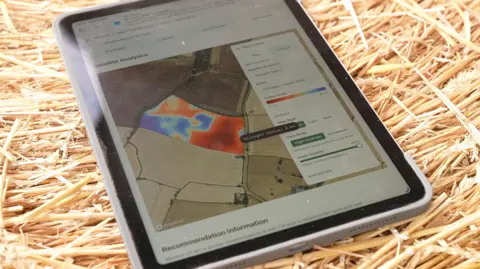
Through that partnership, Manor Farm has teamed up with Messium, which is using satellites to see which areas of land are most in need of fertiliser when crops are growing.
 Janine Machin/BBC
Traditionally, this work has been done by taking samples and sending them off to a lab for testing but Spencer Terry, from Messium, said using satellites could be more efficient.
"We saw satellites as a very scalable way of doing these tests," he explained.
"We use a hyperspectral satellite, which is capable of detecting the actual nitrogen wavelengths from the crops reflecting from the crop tissue.
"It means that for the first time we can measure nitrogen in the crops in a similar way to a lab test, but cover whole farms, several times per season."
 Janine Machin/BBC
The technology analyses the data to show the farm how much fertiliser it needs to use, and where and when to spread it for the best results.
It can also take costings into account to show whether an application is worth the return.
"It's a really tough time for farming," said Penn.
"It's not just the cost of fertiliser, it's the cost of the seed, the cost of the diesel in the tractors for harvesting those crops and paying for labour.
"So much goes into producing a field of wheat. If the margin is not there, we won't be putting crops in the ground. I think anything that saves farmers time, money [and] makes us more efficient... is really great."
 Janine Machin/BBC
'No fertiliser, no food'
Increased costs associated with the war in Iran come only four years after fertiliser prices were hit when Ukraine was invaded.
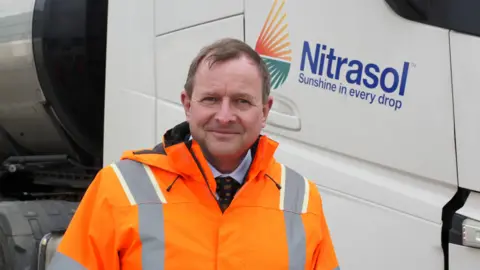
Lord John Fuller, chairman of Nitrasol, a liquid fertiliser producer for the UK market based in Great Yarmouth, Norfolk, said the situation was "really difficult".
He said: "Four years ago, at least the Qataris could supply the Far East market... India and China.
"In the current market, everyone is chasing for a limited supply. We're having to compete for difficult cargos and bring them in in a timely manner.
"British farmers rely on nitrogen fertiliser to grow crops and make beer, butter, meat, milk, cheese and all sorts of things.
"We are the start of the food chain. People think the food chain starts with the farmer, but we're at the start. No fertiliser means no food."
 John Fairhall/BBC
Follow Northamptonshire news on BBC Sounds, Facebook, Instagram and X.
