'They call me papa toad'

 BBC
BBCOn a dark Lincolnshire lane, a small army in high‑vis gathers to help migrating toads reach their breeding pond in safety.
As darkness settles on a country lane near Grantham, dozens of people are searching the verges. Torches switch on, casting their beams across wet tarmac and hedgerows.
This is no late‑night stroll. The Belton Toad Patrol is out for one reason only: it's breeding season.
I chat to the volunteers as they work their way along Five Gates Lane in Belton, Lincolnshire, where in the coming weeks hundreds of common toads will make their hazardous journey to a breeding pond.
Many will not get there without help. Last year, patrol members say, 700 of the amphibians were squashed by cars.
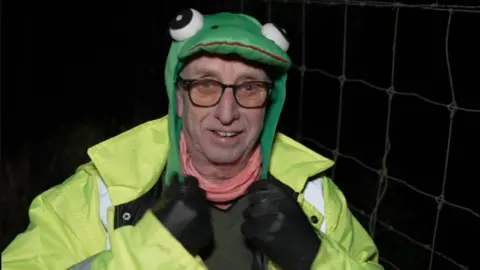
At the centre of the action is Martin Thompson, 71, who has a nickname affectionately used on patrol nights.
"They call me papa toad," he laughs, almost on cue producing a frog‑shaped hat from his pocket and settling it on his head.
Most nights from February through to March, Martin and fellow volunteers fan out along the lane, scanning verges and the glistening road surface for movement.
When they find a toad, it is lifted gently to a bucket and carried to the safer, grassy side.
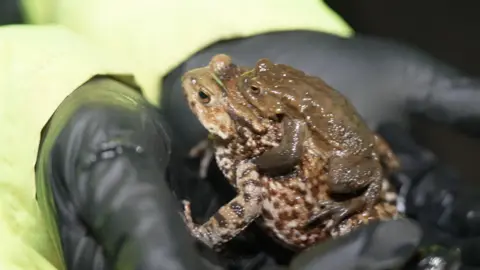
Martin cradles a large female, her mottled back catching the torchlight. "She's got thousands of eggs inside of her," he says.
A smaller male clings to her shoulders in amplexus — the mating embrace toads and other amphibians adopt.
"That's what we do, that's why we're here," he says, placing them down beyond the danger of passing wheels.
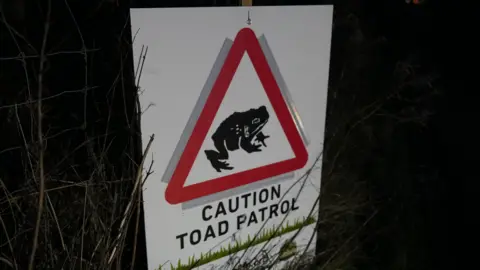
Warning signs now line the lane to slow traffic. Curious drivers sometimes pull up to ask what is happening; the team is happy to explain.
The patrol even has its own code for busy nights, escalating from green to amber and red — and then to "toadmageddon", when buckets are essential to move large numbers quickly.
Emma Hallewell, 52, manages the rota and keeps a running tally.
A small male toad is perched in her hands, occasionally chirruping.
"I think they are misunderstood," she says. "People think they're slimy and ugly, but I don't, I think they're gorgeous."
Emma worries about the pressures on amphibians from new roads and housing cutting across old routes. "We've encroached on their space really," she says.
"They're just great for the ecosystem because obviously they keep the insect numbers down."
The enthusiasm is catching. A voice rings out from the darkness with a mix of surprise and delight: "I've got one."
It is Jeanie, a first‑time volunteer in a yellow high‑vis with a head torch strapped on.
"I'd not heard of it until recently and I just thought it sounds like a really nice thing to do," she says.
"I've never handled a toad before," she laughs, and soon learns the careful, two‑handed lift that keeps the amphibian safe and still.
Why does a toad cross the road?
To literally get to the other side.
According to Froglife toads are "very particular" about where they breed and "often migrate back to their ancestral breeding ponds each year".
The habit is so strong that "they follow the same route regardless of obstructions."
That can make a modern B‑road, or even a quiet country lane, a lethal barrier on damp spring nights.
On Five Gates Lane, the torches sweep back and forth, buckets fill and empty, and the tally climbs.
When the patrol calls "toadmageddon", it means scores — sometimes hundreds — will be moving at once.
As the evening draws in, the shift winds down.
Buckets are stacked, torches click off, and the lane returns to darkness.
The volunteers will be back on the next wet, mild night, ready to help more of the animals as they dice with death in the name of love.
Listen to highlights fromLincolnshire on BBC Sounds, watch thelatest episode of Look Northor tell us about a story you think we should be covering here.
Download the BBC News app from the App Storefor iPhone and iPad orGoogle Play for Android devices
