The great World War Two Banbury deception
On 3 October 1940, a German bomber flew over Banbury, Oxfordshire, seeking Northern Aluminium Company's Art Deco buildings.
Bombs were dropped and success assumed but little did the enemy pilot know they had, in fact, hit a decoy factory.
"Dummy Ally" was a wooden structure built by Elstree Film Studios on farmland near Great Boughton, while the actual factory kept working down the road, crucially supplying the aircraft industry's needs during World War Two.
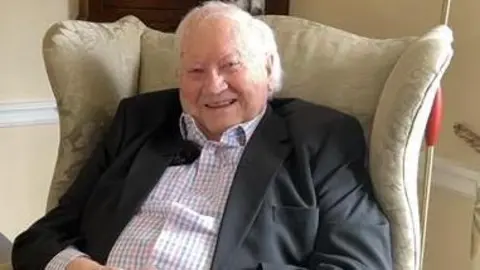
The decoy plan would not have worked without Frederick Mitman, the man who ran the real factory, his son told the BBC.
Radio Oxford's Lilley Noel met Frederick Mitman Jr to find out more about his father's efforts to outwit the Luftwaffe and keep Britain's planes in the sky.
During the war, the Northern Aluminium Company sheet rolling factory worked in conjunction with an aluminium recycling plant near Adderbury which processed metal from crashed English and German planes.
It employed around 4,000 people at its peak, many of them women.
"He worked all the hours that God gave, he really did," Mitman Jr said of his father. "He worked harder than anyone, he never slept, he did what was necessary."
Now aged 92, Mitman Jr recalled first seeing Dummy Ally as a young boy.
"I remember distinctly, the windows were painted in aluminium colour paint but they looked like real windows. It looked like a working building," he said.
"His own factory, they camouflaged. They had their normal camouflage that you see in films covering tanks and guns - sort of netting with bits of tree in it - so they made those almost invisible, but they left the dummy factory open."
When the weather was bad, local farmers were allowed to keep their livestock inside the dummy structure, said Mitman Jr.
"They kept pigs and chickens in there and when they dropped bombs, they blew it to bits and blew all the chickens and pigs to bits too. I was very upset because what had they done to get bombed?"

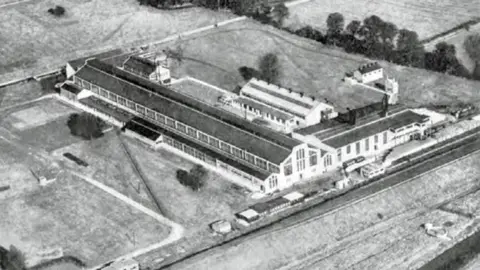
Keeping the actual ally running during World War Two was important.
Until 1942, it met 60% of the aircraft industry's needs and the territorial army manned four anti-aircraft gun posts around its perimeter.
Mitman Sr's work continued in the ministry of aircraft production and his son remembers important members of the government gathering at their home.
Did Winston Churchill ever visit?
"I have vague memories of a man with a cigar but I can't say for certain," said Mitman Jr.
Evacuees stayed and, at one point, some silver-winged aeroplanes close to the young boy's heart were concealed under horse chestnut trees in the garden.
"The Spitfire is not a big aircraft but to a seven-year-old it's enormous," he said.
"It was dangerous to leave a lot of them in the airfields from which they worked because the Germans knew where those airfields were.
"They'd taken to attacking Spitfires, which they couldn't beat in the air because it was a rather good aeroplane, but they could beat them if they were all lined up on the ground about to take off.
"The best way to stop them being attacked on the ground was to move the aeroplanes where they couldn't see them, which was under the trees."
 Banbury Historical Society
His father was later awarded a CBE by the King but it was a letter from Lord Beaverbrook, then minister of aircraft production, in 1942 that means the most to Mitman Jr.
It read: "I was glad to get your letter when I returned from America. Always I will look back with joy and gratitude to the days when we worked together through the storm and when you did so much for which I was given the praise.
"It's no exaggeration to say that if the aluminium factory in Banbury had been bombed, the course of World War Two would have been very different. So we will add Frederick Mitman Senior to the long list of people we need to be very grateful for."
His son said: "I believed in him, I believed in what he was doing and I believed without him a lot of those things wouldn't have been done and maybe it would have worked out not so well, but we won."
You can follow BBC Oxfordshire on Facebook, X (Twitter), or Instagram.
