Rubio speech signals US-Europe relations are bruised but still friendly

 Reuters
World leaders, including French President Emmanuel Macron, German Chancellor Friedrich Merz and UK Prime Minister Sir Keir Starmer, have been gathering in Munich for Europe's biggest security and defence conference.
The burning question on everyone's minds: is the US still an ally of Europe?
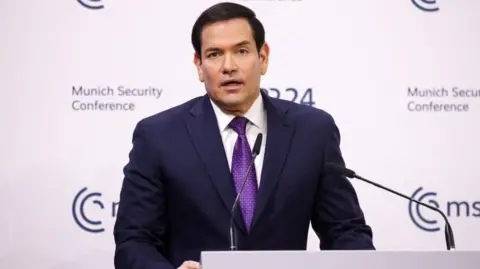
The keynote speech that everyone was waiting for was from Marco Rubio, the US secretary of state.
Would he repeat the attacks made on Europe last year by the US Vice-President JD Vance? Or would he be conciliatory?
The hall was packed to the rafters. Generals and admirals, bemedalled in their uniforms, prime ministers and presidents, diplomats, ambassadors, US Congressmen and women, European politicians and their Spads - all waiting nervously to hear what President Donald Trump's top diplomat had to say.
The applause did not come straight away. In fact, for the first few minutes, as Rubio got into his stride, it began to sound very much like a repeat attack on Europe.
Free trade, mass migration, green policies on climate change – all came in for sharp criticism.
He even talked about "a climate cult" that was harming America's economy, while he went on to slam the United Nations, saying it had failed to resolve the conflicts in Gaza and Ukraine.
The US secretary of state, impeccably neat and groomed, stood with one hand casually in his trouser pocket, delivering this from a prepared script at a podium.
But then he spoke the words everyone in the room wanted to hear: "Our destiny will always be intertwined with yours (in Europe)."
"The end of the transatlantic era," he went on to say, "is neither our goal nor our wish... we will always be a child of Europe".
Rubio spoke of "unshackling creativity", of shared goals in securing supply chains for critical minerals, and of the European culture he so admired, a continent that had given the world Shakespeare, Mozart and the Rolling Stones (he got a muffled laugh for that).
But there was a sting in the tail. What we have together, he said, was unique and "we in the US have no interest in being polite and orderly caretakers of the West's managed decline".
So what did people make of this? It was broadly positive – about half the audience stood up at the end to applaud him.
There was certainly a palpable sense of relief that after all the upsets of the last few months, with tariffs and the threat of a US grab for Greenland, the transatlantic alliance was not dead.
"It was a good speech," Kaja Kallas, the EU's top diplomat, told me afterwards.
"I think the Europeans sighed with relief because it was saying that Europe is important, that Europe and America are very intertwined and good allies, and have been for so long and will be in the future."
She did not deny, though, that there remain real differences in policy in some areas between Washington and Europe.
And while both sides agree that Europe needs to shoulder much more of the burden for its own defence, I have encountered some quiet exasperation here in Munich at Trump's refusal to put enough pressure on Russia to end the Ukraine war, that is poised to enter its fifth, bloody year.
