What is it like growing up in a new town?

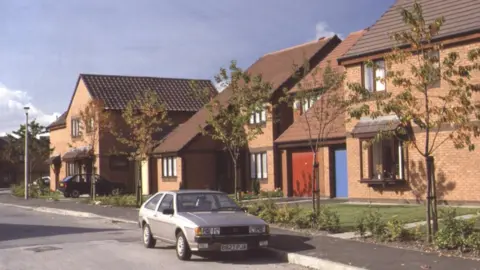 Reproduced courtesy of Cheshire Archives
With the government confirming plans to build more new towns, what can be learned from people who have lived in the originals?
A proposed new town in Adlington has been ruled out by the government but Cheshire did get one in the 1960s, on the site of a former ordnance factory in Warrington.
What was it like to grow up there?
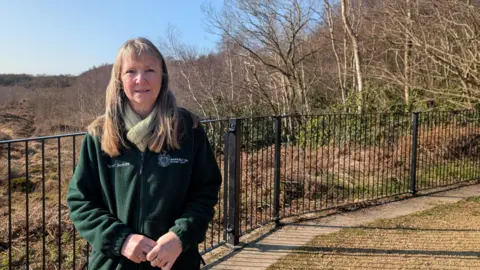
"Still people are learning about just how green this area is," says Gaynor Kerry.
She has been a ranger, working at sites in the Birchwood area of Warrington, for nearly 40 years.
It is clear that Gaynor loves living here.
"We will get some people who live in the housing estate just behind the trees, people who say 'I've lived here for 30 years and I've driven past these gates and I've only just decided to pop in and have a look'."
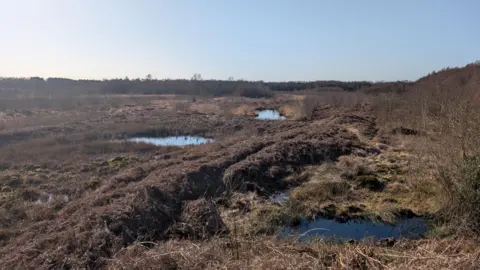
When people think of new towns they might not necessarily think of green space, but it is actually an integral part of Birchwood's story.
"It's all down to the original landscape designers," she explains, "because it was a whole sort of ethos of 'let's make it green'."
And that green space is home to a few unusual residents.
"We have slow worms, common lizards and some adders," Gaynor explains.
Adders - the UK's only venomous snake - living in Warrington?
"Absolutely!" she says, adding that they can even sometimes venture away from the nature reserve area.
"As we are so surrounded by houses here, they can sometimes wander out and find a nice place to sunbathe so people might sometimes spot them in their gardens."
It was the 1946 New Towns Act that led to the creation of new towns, with 32 designated between 1946 and 1970.
Warrington's new town was in the third wave, with areas including Central Lancashire, Runcorn and Skelmersdale also receiving new town designation.
The town of Birchwood is made up of three areas: Gorse Covert, Locking Stumps and Oakwood.
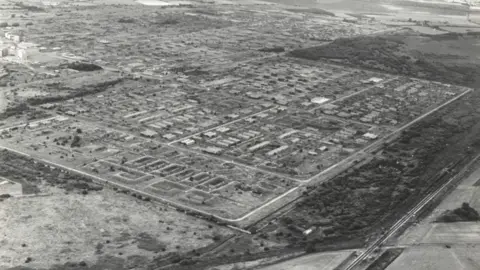
At the outbreak of World War Two, a Royal Ordnance Factory - ROF Risley - was built in the area where shells, mines and bombs were filled for the war effort.
An archaeology study by Lancaster University in 2000 said the site had previously been mainly agricultural.
After the war, part of the site was used by the Ministry of Supply for atomic energy research and the rest by the Admiralty as a storage depot.
The site was then acquired by the Warrington New Town Development Corporation in 1968, with it soon being designated as a new town.
According to Cheshire Archives, the outline plan for the site was completed in 1972 and approved by the government a year later.
By 1981, about 3,500 rented houses - alongside industrial units, office space and commercial units - had been completed.
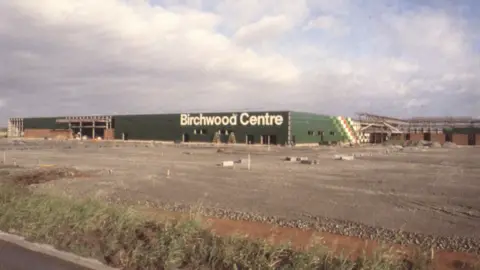 Reproduced courtesy of Cheshire Archives
Thousands of people moved in to become residents of this new, utopian location.
Dr Suzy Fitzpatrick was one of them.
After growing up in the town, she is now a senior lecturer in human geography at York St John University.
In 2017 she launched a research project about Birchwood called Days of the New Town.
It was followed by a photography exhibition at Warrington Museum.
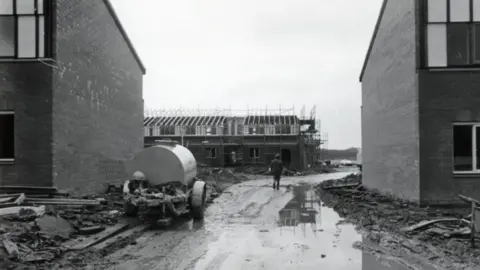
She says one of the things she remembers from being a child was that everything seemed "brand new".
"You were surrounded by all these trees that - when the sapling is first growing - it's belted on to a wooden strut with a black belt.
"And I grew up thinking that all trees needed those black belts around them, because I hadn't thought about why they were there."
'Lived heritage'
She said it was coming across work by French socialist philosopher Henri Lefebvre - who wrote about how lived experiences shape the places in which people live - led to her making an "immediate connection" with Birchwood and conducting research on her home town.
The new town was led by the Warrington Development Corporation and Suzy says the area's "treasure trove" archive was "really, really well kept".
The exhibitions Suzy organised were "completely supported" by the local community, she says.
"They were loving seeing all these old photographs which I think if they didn't get a public hearing, nobody would know that they were there.
"It was about getting a sense of the community - here's your recent lived heritage that we don't really talk about," she says.
Suzy says there was "no financial mechanism" for long-term funding in Birchwood after the development corporation was wound down.
She also highlights how some of the UK's garden cities in the early 20th Century were held in community ownership, something which did not happen with the first generations of new towns.
"To keep those utopian planning principles alive, what you do is plan for the future," she says.
She says the design and ethos around Birchwood was "unique".
"The approach of building houses in parkland or in forests, that has not been done anywhere else in Britain to the extent that it was done in Warrington.
"So it's quite a singular example of what we now call eco-planning."
So is Suzy proud of where she's from? And from her work, does she think it is hard to create a sense of pride in a newly created place?
She says "place identity" is "really interesting" when it comes to new towns.
"What planners are trying to do is to build somewhere, but they're also trying to harness this sense of identity and belonging."
 Reproduced courtesy of Cheshire Archives
Nick Jackson moved to Birchwood aged nine.
He also says he remembers everything being "brand new".
"I think there was a lot of optimism, I think because everything was new and fresh, it was quite an optimistic sort of time."
For the exhibition, Nick returned to take photos at some of the locations featured decades ago.
He says he noticed some changes, particularly around green spaces becoming more overgrown and there now being fewer playgrounds.
"You've got areas that in my mind were really great as a kid but are in some cases a bit overgrown and neglected," he says.
"I've tried to be objective about it and we're very lucky to live in a very green area."
He highlights some of the community organisations in the area, such as the Friends of Birchwood Forest Park, of which he is a member.
But what does he think about the challenges of building a community in a new town?
"I've always felt the community has been pretty strong in my experience.
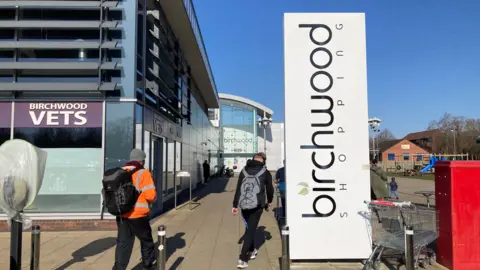
"A lot of people move away but there's still quite a lot of people you see in the shopping centre or somewhere."
Indeed, Nick did briefly move away from Birchwood before coming back.
He says there are "pros and cons of living in a new town".
"We've got a decent shop, a decent pub, a decent school," he says, before musing: "That's all we've got" and bemoaning the fact he has to travel further for more shops, bars and facilities.
Overall, though, he appreciates the green space.
"I can literally see the trees over there, and I'm away."
 Reproduced courtesy of Cheshire Archives
Today, there's been local opposition to some proposed new towns, including notably in Adlington, which had been on the government's initial shortlist.
Back in the 1960s, similar questions were being asked about Birchwood.
In one Parliamentary debate from 1964, Manchester Openshaw MP Charles Morris said: "This location will make almost total the urbanisation of the whole of the South Lancashire area between Liverpool and Manchester."
The Housing Minister of the time, Sir Keith Joseph, disagreed with this assessment.
Another MP, Warrington's Thomas Williams, also asked what discussions the government had had with the local authority over the plans.
The minister responded that the councils had been informed and they would be fully consulted later on.
'Final locations'
This also has echoes of discussions between the government and Cheshire East Council in Adlington, with some councillors mentioning they felt there had not been enough transparency about the process.
With Birchwood now more than 50 years old, what does Suzy think of the new towns concept?
She thinks that while new towns have achieved a lot, some of them have "not aged as well as others".
The government has confirmed seven locations will go forward to potentially be in the next phase of new towns, including Victoria North in Manchester.
There will be more consultation before the final locations are confirmed later this year.
See more Cheshire stories from the BBC and follow BBC North West on X. For more local politics coverage, BBC Politics North West is on BBC One on Sunday at 10:00am and on BBC iPlayer.
