'Food bank usage a sad picture of our community'

 BBC
BBCFood banks in Guernsey say they are seeing more dual income households using their services.
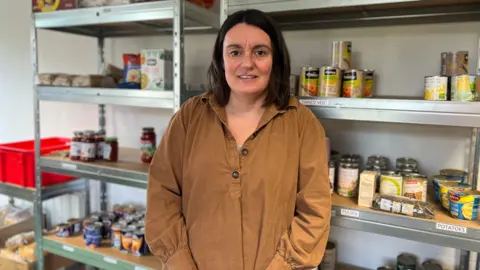
Chrissy Salmon, team leader at Shiloh Church, said over the past six months they had seen "a lot more people coming through" as well as a lot "coming for the first time".
According to a 2024 survey by the Guernsey Community Foundation, 36% of the island's lowest income households had reported using a food bank but Salmon said the demographic was now shifting.
"What's really changed is that you've got two people working in a home" who "still aren't being able to meet the needs of what the family life entails," she explained, adding: "I think it's a sort of a sad picture of our community at the moment."
Salmon put the change down to islanders finding the cost of living, particularly rents, high.
According to the latest property price bulletin, the average rental price is £2,112 a month.
The "extra need" means there is a stretch on the food bank, she said.
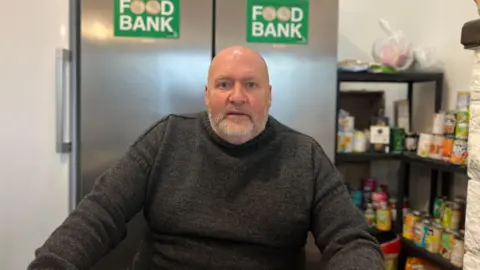
Simon Fairclough, manager of the Guernsey Welfare Service, said while its food bank's stores looked full, if they stopped receiving donations their stocks would "empty in about a week".
He said in 2025 the service had seen about 720 different households.
But so far this year, it was seeing, on average, five new households a week, he said.
"I think probably a lot of people have got in their minds the sort of person who would come to a welfare office, well, forget that, we see a whole range of people here."
Politicians are currently debating bringing in a Goods and Services Tax (GST), which could include food, if the States Assembly approves the preferred option of the government's most senior committee, Policy and Resources (P&R).
Fairclough said while support was likely to be made available to households that qualified, it could still affect donations to the food bank.
"You would think that the price of that going up, people will feel less able to help. We just hope that we can continue to rely on the generosity of the community."
'Recognising' the problem
Jim Roberts, chief executive of the Guernsey Community Foundation, said there was a steady and "alarming increase" in food bank usage.
He agreed with Chrissy Salmon's assessment that the extra squeeze was often down to rent prices.
"Private rents have increased by around 60 to 65 percent since 2018, and by 50 percent since 2020, you don't need to think very long before you realise, well, wages have not increased by a comparable amount."
In November, the President of the Housing Committee, Deputy Steve Williams mentioned that the possibility of introducing a rent cap in Guernsey would be looked at.
Roberts said "a fundamental importance" was "recognising that we have a problem".
He said it was a problem that needed to be tackled from the ground up: "You're talking about economic growth in the hope that it trickles down to everybody."
He added: "Making certain services free to access, even if they're paid for elsewhere, adjusting benefit rates so that at least you ensure the lowest income households are adequately protected, or otherwise you're looking at, sort of, trying to control costs in other ways such as rent control."
Follow BBC Guernsey on X and Facebook and Instagram. Send your story ideas to channel.islands@bbc.co.uk.
