No collusion between security forces and UVF in bombings - report

 Getty Images
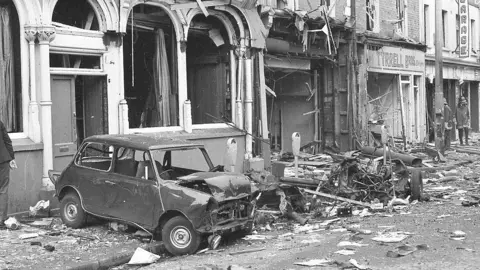
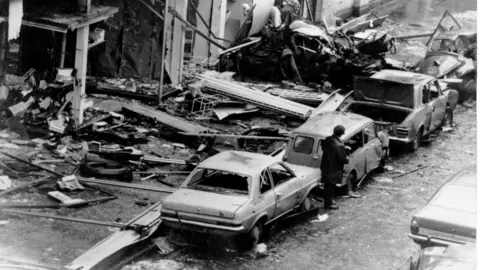
There is no evidence UK security forces co-operated with the Ulster Volunteer Force to carry out the 1974 Dublin and Monaghan car bombings, a review has concluded.
Thirty-three people, including a pregnant woman, were killed in the four explosions, which occurred without warning.
Detectives re-examined the bombings as part of a wide-ranging review of scores of loyalist attacks in the 1970s.
The findings are contained in the final Operation Kenova report published on Tuesday.
"This review has not identified any evidence or intelligence which would indicate that British security forces colluded with the UVF (Ulster Volunteer Force) to carry out the attacks in Dublin or Monaghan," the report said.
"Nor has any evidence of state collusion been identified."
Future prosecutions 'extremely unlikely'
Claims of collusion have persisted for years.
The review stated the UVF was "independently capable" of carrying out the bombings without any help.
No-one has ever been charged over the attacks and the review states prosecutions in future seem "extremely unlikely".
It added: "There do not appear any realistic opportunities from an investigative or forensic perspective to warrant any form of criminal investigation into these attacks."
 PA Media
The review, known as Operation Denton, also looked into a wider series of UVF attacks attributed to the so-called Glenanne gang.
It has been blamed for around 120 killings throughout the 1970s.
They include the 1975 Miami Showband massacre, when three musicians were shot dead.
The gang's principal base was a farm in the County Armagh village of Glenanne, which belonged to a Royal Ulster Constabulary (RUC) officer, James Mitchell, who is now deceased.
It has been alleged the gang's members included other police officers, as well as soldiers in the Ulster Defence Regiment (UDR).
The review found "clear evidence" of the active involvement of members of the security forces "in a number of individual cases".
It went on: "This collusion involved extremely vicious and serious criminal activity, including bombing attacks and murder."
It said UVF "members or sympathisers" existed within the Royal Ulster Constabulary (RUC), the Territorial Army and the Ulster Defence Regiment (UDR).
'Families want the truth'
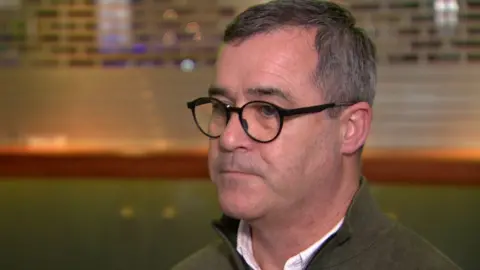
Margaret Irwin, who represents families affected by the Dublin and Monaghan bombings, said while she accepted the central finding, it did not prove there was no collusion .
She said the report highlighted a "dearth of information", namely there is little to no information about who made the bombs, where they were stored or collected or the route taken.
She added that the families will take stock after the full report is published.
Alan Brecknell, whose father Trevor was shot dead in a bar in Silverbridge in south Armagh in 1975, said the report found collusion had been "wide-known and accepted within society here".
"It's heartening to hear that because sometimes I think it hasn't been widely accepted," he told BBC News NI.
There could be a lot to learn from how families have been treated as part of both Operation Kenova and Denton, he said.
"There has been a humanity there that has been lacking in the past," he added.
'Inappropriate' relationships with UVF members
The report also found that the UVF was supplied with intelligence by "corrupt" individuals.
A number of RUC officers had "inappropriate relationships" with members of the Mid-Ulster UVF.
"Whilst there was clear collusion between some members of the UDR and RUC... the review has not discovered any material which indicates the security forces systematically collaborated with prolific offenders.
"Or that any individuals or groups were organisationally 'protected' by the security forces.
"However, Operation Denton recognises if it were the case, it is unlikely there would be records either made or retained which would reflect this."
Taoiseach (Irish Prime Minister) Micheál Martin said he regretted that the full Operation Denton report had yet to be published.
However, he said there was a "seismic" finding in the summary report which said a network of loyalist paramilitaries, aided by members of the RUC and UDR, was responsible for murdering around 120 people.
