'Zip-up' EV chargers arrive on terraced streets

 Kerbo Charge
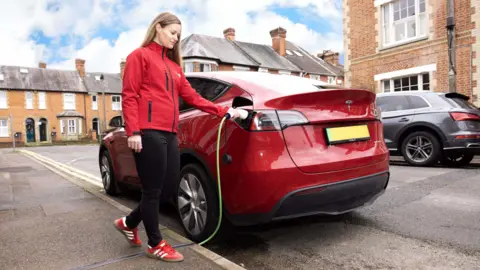
"Zip-up" charging channels for electric vehicles have now been installed on terraced streets where homeowners may not have driveways.
Bradford Council has provided the cross-pavement channels to enable drivers to run a cable from their home to a parked car safely.
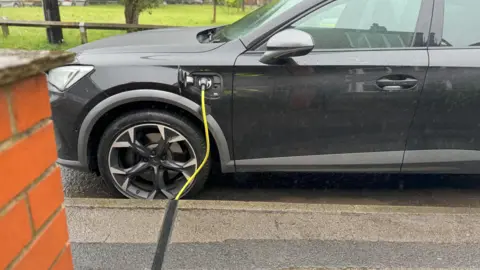
The Kerbo Charge pilot project was funded by a £2.87m government grant and the technology avoids the cables becoming a trip hazard by "zipping" them beneath the path during use.
Alex Ross-Shaw, the council's regeneration, transport and planning spokesperson, said improving access to home charging was "vital" to cutting emissions.
 Kerbo Charge
The channels work by allowing residents to seal their cable in a gully with a self-closing lid which closes flat again when the charge is complete.
The first roll-out of the scheme is for homes that have a reserved parking space outside, such as disabled bays.
It will then be expanded across the district. Bradford Council owns and maintains the charging channels, but residents are responsible for keeping them clean.
One of the first installations was outside the home of Lisa and Peter Newsome, who are both disabled.
Mrs Newsome explained: "We rely on carers to help us get around.
"Being able to charge our car outside our home means we don't have to spend hours waiting at slow public chargers, so our carers can focus on helping us with other things."
Recent Department for Transport figures showed that Yorkshire and the Humber was the worst-served UK mainland region per 100,000 of the population for the number of electric charging points available.
Aaron Foulds from Keighley also recently had a charging channel installed.
He said that he was paying more than the equivalent fuel cost to travel to and use public charging facilities.
He drives an electric car in part because he suffers from asthma.
"Driving an electric vehicle helps reduce exhaust fumes," he said.
"Now that I can charge at home, it's also much more convenient and cheaper than using public chargers."
Estimates suggest that on the basis of some overnight tariffs for domestic electricity, a full charge can cost less than £5, compared with around £30 for using a public charge point.
Campaigners have highlighted the prohibitive costs of public charging points as a major factor in slowing the take-up of electric vehicles, and have called for improvements to home charging in urban areas where there are fewer properties with private driveways.
In Bradford, the council has pledged to install 1,000 new charging points in 230 locations by 2027.
Residents can check their eligibility for the scheme and apply through the authority's website.
Listen to highlights from West Yorkshire on BBC Sounds, catch up with the latest episode of Look North.
