'I can't hear when aids are off': Parents back newborn hearing test

 BBC
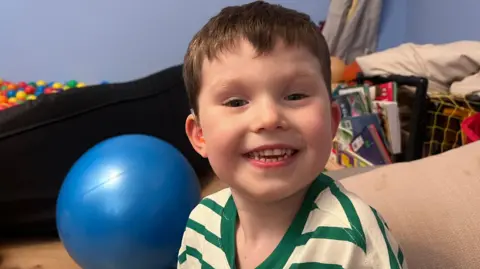
BBCIsaac has been wearing hearing aids for most of his four years. His current ones are in his favourite colours of blue and orange.
"When I go to bed, I take them off," he said. "I can't hear then".
Isaac has permanent hearing loss in both ears and his deafness was picked up soon after birth, thanks to a newborn hearing screening programme.
His mum, Louise McAleenan, is grateful she took up the offer of the test as it has "made all the difference in the world" to Isaac, and she would encourage all parents to do the same.
Louise McAleenan said the early referral, diagnosis and intervention gave them the last four years to help Isaac and meet his needs.
"I can't imagine what Isaac would be like now had he not had that test and we had to wait until we did have concerns or until things were picked up, and waiting lists and things like that, I think that would have had a massive impact in how he has flourished," she said.
Not easy finding out your baby isn't 'perfect'
Louise works with children with special needs and while she said "finding out that you don't have a perfect baby is never easy to hear", she was not fazed.
But she did feel "enormous pressure to do everything that I could to make sure that it didn't make a difference".
"I have the privilege of working with children with a range of abilities and disabilities, and I see first hand what beautiful lives they lead and how everybody does look different and can still live a very fulfilling life," she said.
She said being able to access services early meant Isaac had been able to develop his language skills and go to a mainstream school, which he loves.
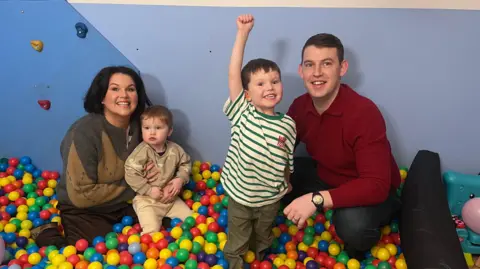
Isaac has sensorineural hearing loss - caused by damage to the hair cells inside the inner ear, or damage to the hearing nerve, or both.
It makes it more difficult for him to hear quiet sounds and reduces the quality of sound that he can hear.
Hearing aids like wearing a watch
He had hearing aids fitted at eight months old - "a big day" that "changed his life".
Louise said Isaac is not only part of the deaf community, but also the hearing community thanks to his hearing aids, which give him a way to hear the world, albeit not in exactly the same way as she would.
Without them, she said, life would be different and more difficult for him.
She said Isaac "hears everything but in a very artificial way" - all sounds are amplified, and his brain needs to work harder to process what he should be paying attention to.
"Having them consistently for this length of time has meant that now they're just part and parcel of him," she said.
"He just wears them the same way that you and I would a watch."
Early screening also meant Isaac had vents fitted within months of getting his hearing aids to resolve another hearing issue - glue ears - rather than having to join a waiting list.
More than 4,000 children are on a paediatric waiting list for ENT (ear, nose and throat) where the typical wait is 18 months, according to the latest figures by the Department of Health.
Almost half a million babies screened
The newborn hearing screening programme, which has been running since October 2005, is offered to all newborns in Northern Ireland
One or two babies in every 1,000 are born with a permanent hearing loss in one or both ears.
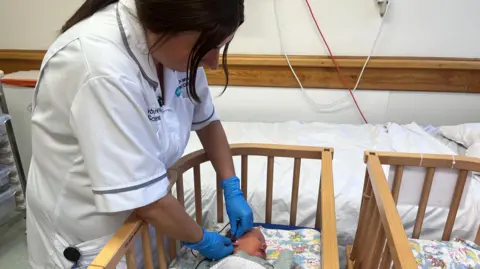
Martina Rafferty is a newborn hearing screener in the Belfast Trust.
"We put a small tip in the baby's ear, and we play very small sounds into the ear to see if we can get a response," she said.
"The ear gives off the response and the machine measures how well that's coming through and if it's getting the nice reading, then it will tell us that it's a pass and that everything is developing normally," she said.
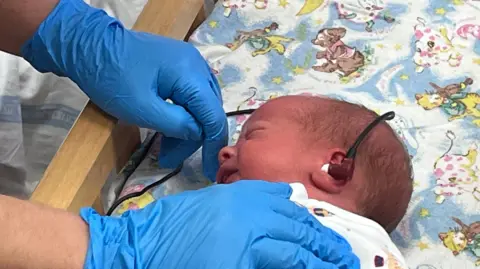
Ms Rafferty said babies can fail the screening initially as a lot of them "still have birth debris in their ears" which can prevent a clear reading, as well as noisy wards, so they do the screening test twice.
If they do not pass, she will try again the next day if the baby is still on the ward or parents are invited to come back from an outpatient appointment.
Another fail leads to another screening and if there is still no clear response, the baby is referred to the audiology department for further tests.
According to the Public Health Agency (PHA) nearly half a million babies have been screened through the programme.
Dr Adrian Mairs, public health consultant in the PHA, said the aim of the programme was to identify hearing loss early because "we know that early identification, early diagnosis and early intervention is associated with a better outcome for these children, in particular in relation to speech and language development".
