Less invasive robot surgery to speed up recovery

 South Tees Hospitals NHS Foundation Trust
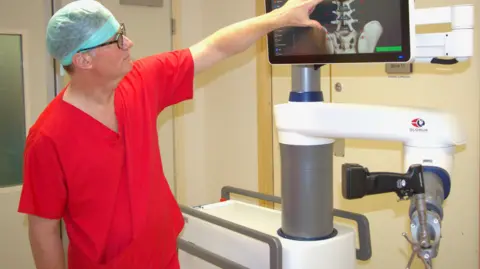
New robot technology for "keyhole" spinal surgery will increase accuracy and improve outcomes for patients, hospital bosses said.
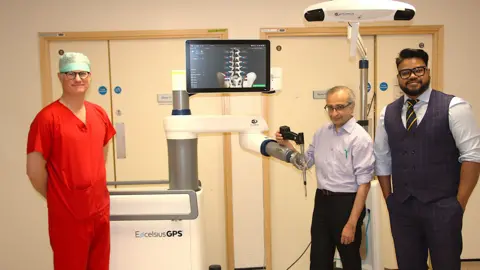
James Cook University Hospital in Middlesbrough said it will be the first in the region to introduce the £1m equipment next month, and that an hour-long operation would take "minutes" and be less invasive.
The ExcelsiusGPS will use 3D scans to help surgeons perform spinal implants reducing the risks of complications as well as recovery time.
Consultant spinal neurosurgeon Simon Tizzard said: "I think it is a major step forward for patients in terms of what it's going to be able to deliver for them, their recovery, the overall experience and safety."
The surgery involves inserting screws into the spine in cases where it requires extra support, or when curved spines require a procedure to straighten them.
Tizzard said until now, to carry out the surgery accurately a "large wound" needed to be made to avoid damage to "vital structures" including nerves, spinal cord and blood vessels.
Using the robot will require a smaller incision and also lower infection risks, speed up operation times and reduce blood loss.
 South Tees Hospitals NHS Foundation Trust
The 54-year-old said he was "excited" to offer the "clever" technology to patients and believed "the state-of-the-art robotic system" would help reduce hospital stays allowing more patients to be treated quickly.
He said: "The ExcelsiusGPS represents the most advanced robotic spinal navigation system currently available worldwide.
"It is used in over 500 hospitals globally, performing complex spinal surgery and is the first of its kind to be introduced in the region."
He said it could be used in "big operations" with a long recovery time especially for older patients and using the robot would mean they would be under anaesthetic for less time.
"They will usually recover quicker from surgery and be able to leave hospital much quicker," he said.
