Robot-assisted surgery marks 1,000th procedure

 University Hospitals Tees
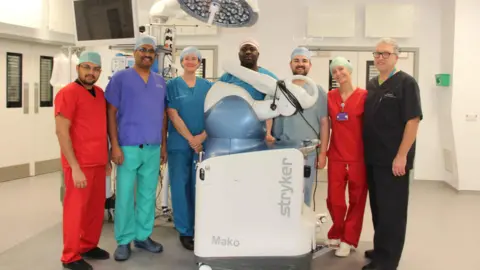
A hospital has carried out its 1,000th procedure using a specialist robotic arm on patients undergoing hip and knee replacement surgery.
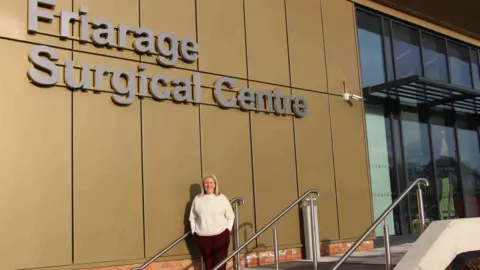
It was introduced 18 months ago at the Friarage Surgical Hub in Northallerton, North Yorkshire, which is a part of University Hospitals Tees.
The hospital said the technology had made surgery individualised and allowed patients to recovery quicker.
Edwina Fogg, who received a partial-knee replacement, said it was "a privilege" to be the milestone patient, and thanked the surgeon and his "amazing" team for looking after her and giving her the chance to experience the new surgery.
After suffering from problems with her knee, Fogg, who is from North Yorkshire, said the pain had become unbearable and she found it difficult to complete everyday activities like walking and sleeping.
 Supplied
She said the date for her "less invasive" surgery came "much sooner" than expected and the procedure was "painless".
"I am delighted that I am now on my journey to recovery so I can start getting back to doing the things I love without being in constant pain," she said.
'Transformed surgery'
Consultant orthopaedic surgeon Andrew Port, who is one of seven consultant surgeons now trained to use the technology, said the investment in the surgical robot "has transformed NHS care for the better".
"We can now create a plan that is bespoke for every patient and their individual requirements and plan exactly where we want to place the hip or knee, while taking into account the size, shape and rotation, which just wasn't possible before," he said.
During the operation, the robotic arm is controlled by the surgeon, giving them precise control of their instruments.
"Patients don't require as much physiotherapy or rehabilitation and are back to doing the things they love much sooner than expected, with many even forgetting they've even had surgery within six months," Port added.
He said with patients spending less time in hospital, surgeons could carry out more operations "significantly" reducing waiting times.
 University Hospitals Tees
Physiotherapist Danielle Gash underwent a partial-knee replacement in October using the robotic technology.
"Before the procedure, I was struggling at work and with the activities I wanted to do, such as walking my dog, cycling and keeping up with my family," said the 53-year-old from Teesside.
"Since my surgery, I have been completing daily rehab exercises, going out on walks, using my static bike and have even been videoing my journey in the hope to inspire others."
She said she felt "very reassured and confident" and "honoured" about being operated on using the robot.
