Ambulance 'allowed to refuel' on way to dying man

 Family handout
An ambulance crew was "given permission" to refuel on the way to a man who would die waiting for help, paramedics have told an inquest.
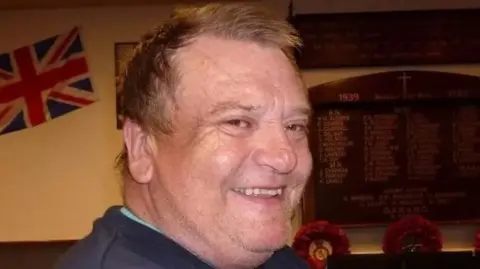
Peter Coates was left struggling to breathe after his oxygen machine stopped working at his home in Dormanstown, Redcar, in March 2019.
Paramedic Sharrona Golden, who was part of a second North East Ambulance Service (NEAS) crew sent to Coates, said she asked the control room: "Can we get some fuel because we're only only one bar?"
The inquest heard when it was refuelled, the ambulance had 29 litres (six gallons) of fuel, equal to half a tank. The coroner Paul Appleton asked Golden "do you accept the ambulance had more fuel in it?", to which she replied: "Yes."
A power cut just before 04:00 GMT on 14 March 2019 caused Coates' oxygen machine to fail and he called an ambulance to his home.
The inquest at Teesside Coroner's Court previously heard a first ambulance was unable to leave the ambulance station when the gates were jammed shut during the power cut.
Golden said her crew was given permission to refuel the ambulance on the way to Coates, adding it would not be "unusual" to refuel while on a call.
'We don't question control'
Golden told the inquest she believed the fuel level in the vehicle was low.
She said crews needed to have enough fuel in case they were diverted to locations a long distance away, like Newcastle's Royal Victoria Infirmary.
"You don't have any idea what's going on in the control room," Golden said.
"You don't know what calls are coming in."
Julie Tait was the more senior of the two paramedics on the ambulance.
She told the inquest they asked control if they could refuel before they were allocated to Coates, who was classified as a category two case.
Category two is the second highest level of emergency and allocated to people with serious conditions, such as a stroke.
But once the call came in, they refuelled en route to Mr Coates.
The coroner asked Tait: "Was it appropriate to refuel en route?"
She replied: "We had been assigned a category two call but control gave us a direct instruction to continue refuelling.
"We don't question what control tell us to do."
She said she had since had training in refuelling and NEAS crews would now stand down from a job if they needed fuel.
Delay finding key
Golden said they arrived at Coates' house at 04:38, 37 minutes after his emergency call.
She said there was then a 10-minute delay gaining entry to the house as the crew tried to find a key safe for the property.
She said her ambulance crew notes recorded there was a key safe and she had a code for it, but the location of the safe was not recorded.
The inquest heard the crew eventually found the key safe using torches down the side of the property.
They went into the house which was in darkness and found Mr Coates on his back on his bed with his limbs "very firm and solid".
Golden said she checked his heart and pulse but rigor mortis had "just started".
"If he had been breathing we would have done everything in our power to save him," she said.
No gate training
The inquest previously heard the former blast furnace worker at British Steel had chronic obstructive pulmonary disorder, which left him with breathing problems.
Paul Elstob, part of the NEAS operational leadership team, told the inquest that 10 minutes passed between the first paramedic crew reporting that they could not get through the Redcar ambulance station gates and a second ambulance being deployed.
He said the gates could have been "manually overridden", but at the time ambulance crews were not trained to do this.
Appropriate training was now given to ambulance staff, he said.
A local level investigation by NEAS in Coates' case had initially classified the incident as "low harm".
Mr Elstob said it was not until 2022 that the case was reopened as a "serious incident".
When asked by the Appleton why it took so long, Mr Elstob said a "faster action review" was now in place for all safety incidents, which were reviewed on a weekly basis at divisional level.
The inquest was adjourned to a date yet to be fixed.
