'You don't know what you'll face' - nurse on domestic abuse training

 BBC
BBCNursing students at Queen's University Belfast (QUB) are set to receive "groundbreaking" training to help them spot signs of domestic abuse - the first of its kind in the UK.
The Unlock Safety Initiative hopes to equip 600 prospective nurses a year with the skills to recognise abuse, respond to disclosures and connect patients with the appropriate support services.
It comes as police recorded almost 30,000 domestic abuse incidents in Northern Ireland between June 2024 and 2025 - accounting for about 20% of reported crime.
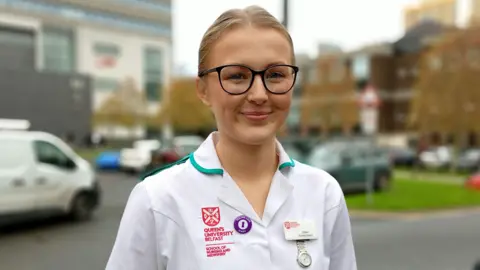
Student nurse Jenna Watt said "you don't know what you're going to be faced with" in hospital so the training is "really informative".
The initiative was developed between QUB and the Women's Aid Federation Northern Ireland, the Royal College of Nursing (RCN) and the Executive Office's Change Fund.
The training will be delivered annually, and will be built into the degree programme as a way of tackling violence against women and girls in Northern Ireland.
Nurses who complete the programme will receive a badge to let patients know they can confide in them.
Jenna Watt said spotting domestic abuse in hospital when you don't know the signs is "worrying" but "this training has been amazing. We know how to ask questions without being too forward and knowing how to signpost and who to signpost a patient too".
"When you're out in hospitals you don't know what you're going to be faced with and who you're going to be faced with and what they have been through.
"So it's good to know you have that training behind you and you know how to go forward with that."
 Kellie-Ann Winchester
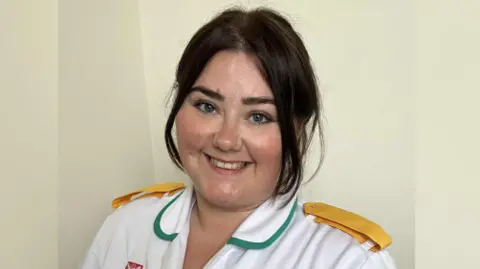
Ms Winchester, a second year adult nursing student, will not receive the training as part of her studies but will attend a launch event for the programme on Wednesday.
She said the training, which will be available from this academic year, will give student nurses "the awareness of domestic abuse", in particular the signs that "aren't always visible to the eye".
Ms Winchester said that will "then obviously lead on to how we communicate as nurses to the public".
"I think it's going to be great for early intervention. You know, getting in early, breaking the cycle and then we can better inform our care as well.
"We could intentionally change lives from the very start which is incredible."
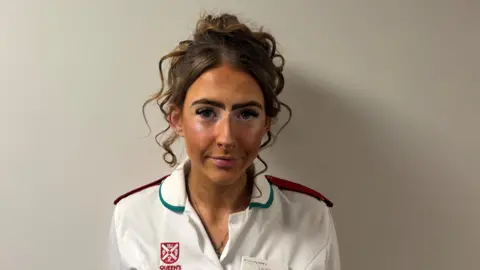
QUB student nurse Louise Bradford said the introduction of this training is "absolutely fantastic" as it could "save a life".
As Ms Bradford is a third year learning disability nurse she will not receive the training, but will attend the launch day.
"If we are being supported to see the signs and be informed of domestic abuse and violence that can happen to the individuals that we care for, it supports us to support them, make a change and maybe even save a life," she told BBC News NI.
She explained as part of her work as a learning disability nurse it is "extremely important" to have this training to "be able to recognise the signs in an individual that could not be communicated verbally".
Preventing domestic abuse
Johanna McMullan, the director of education at QUB's School of Nursing and Midwifery, said what students will learn as part of the programme will leave a "profound and lasting impact".
"Part of our job is to have extremely difficult and challenging conversations with patients in our care, and sometimes we are their first port of call," she said.
"The sad reality is that most of our students who receive this fundamental training will inevitably have to utilise these skills in some capacity throughout their career."
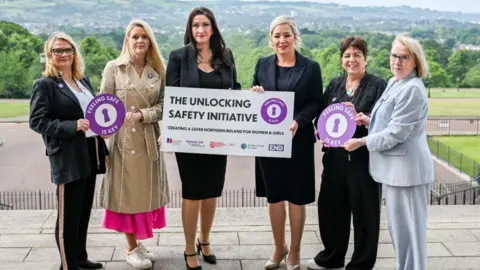
Sarah Mason from Women's Aid NI said the launch of the training on Wednesday marks a "good day on the road to prevention".
In the past year, the charity has supported more than 7,600 women, as well as 5,200 children, she added.
"We also know that pregnancy can be a trigger for domestic abuse and in the last year Women's Aid supported 266 women who were pregnant and 10 babies were born whilst their mother was in refuge," she said.
 Women's Aid NI
Prof Rita Devlin, the RCN's director in Northern Ireland, said this was the first step in ensuring that all healthcare workers are equipped to identify abuse, knowing who may be at risk, and how to start difficult conversations.
"With women making up nearly 90% of the nursing workforce, this initiative will prepare nursing students to address domestic abuse from the start of their careers," she said.
If you have been affected by any of the issues raised in this story, information and support can be found at the BBC's Action Line.
