MP shares anorexia experience to raise awareness

 BBC
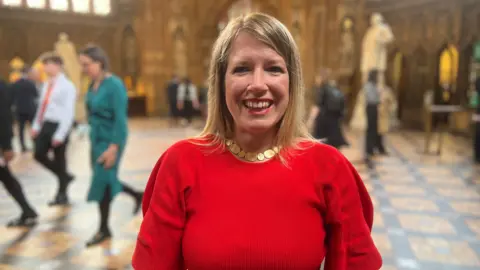
BBCAn MP has said her desire to be a mother "gave me a reason" to overcome anorexia.
Marie Tidball, Labour MP for Penistone and Stocksbridge, spoke in Parliament about living with anorexia in a bid to raise awareness of eating disorders in women with disabilities.
Tidball said her anorexia began when she was 14 after her leg was amputated, and continued for four years. It led to hair loss and her period stopped.
She told MPs: "My desire to be a mother gave me a reason to get better, signalled a future, and made me know choice once again."
Tidball said she had heard from many women with disabilities whose eating disorders were "linked to their own body image and identity", as was hers.
"My frustration about my physical form turned into obsession," she told the Commons during a debate on Thursday to mark International Women's Day.
- If you have been affected by the issues raised in this report, you can access help and support via the BBC Action Line.
Speaking publicly for the first time about her experience, she said: "When they amputated my leg, they amputated a part of me.
"I see my body and I feel disgust, repulsion.
"I fear that my amputation took away my femininity, my ability to be yearned for, my womanhood pauperised, trapped in a body that does not reflect my mind or myself.
"Anorexia, unplanned, like an addiction, crept upon me.
"I ate less and became thinner, my wish: that nobody would notice my disability and I would simply disappear. A physical escapism.
"For the first time in my life, the eating disorder gave me control over my body the way it looked, the way it felt. My frustration about my physical form turned into obsession.
"The obsession fed me, where food did not. It gave me power.
"Success became feeling bones left behind under taut skin, knowing my pelvis protruded below a small waist, cheekbones were prominent on a smile-less face."
'An enormous taboo'
Tidball said: "Somewhere at the back of my head, I knew I wanted to have children. Eventually, I took the pill. My period started again. I ate more.
"I wrote these passages 20 years ago, in my early 20s, while recovering from my last major surgery to my legs.
"I was anorexic for four years from being age 14, and whilst I was physically better by the time I went to university, it took me until my mid-20s to have a healthy relationship with food.
"And I'm not alone. Over the years, I've spoken to other disabled women about their experiences of eating disorders linked to their own body image and identity.
"Devastatingly, 20 years later, two decades after I wrote those passages, social attitudes towards sex, relationships and disability remain an enormous taboo.
"Which means disabled women are still going through this anguish, damaging their mental health, causing them to self harm and eroding their self esteem."
Tidball also pressed the government "to put inclusive maternity care for disabled women at the heart of our women's health strategy".
She said damaging attitudes and a lack of awareness are "leading disabled women to face barriers in public services, including accessing sexual and reproductive and maternity care".
Listen to highlights from South Yorkshire on BBC Sounds, catch up with the latest episode of Look North
