'Remarkable' discoveries under market as dig ends

 ULAS
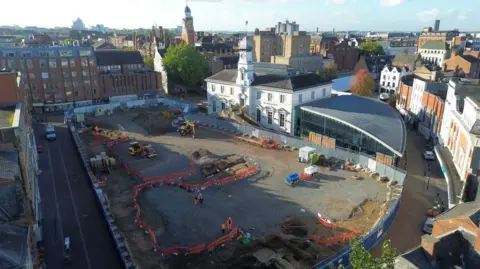
ULASArchaeological excavations that uncovered the remains of a "vile" medieval dungeon under Leicester's market place have been completed.
A team from the University of Leicester Archaeological Services (ULAS) has been working on the site since July and discovered artefacts from the Bronze Age, the Roman era and Middle Ages.
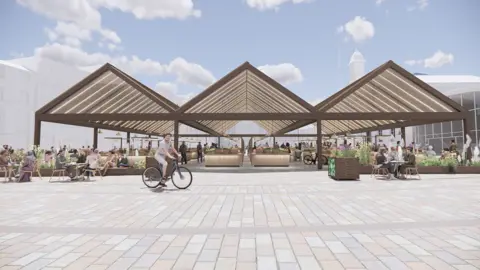
The dig, part of a £7.5m project by Leicester City Council to create a new market square, has offered a unique opportunity to work in a busy city centre site, archaeologists said.
They previously revealed they had found a 16th Century civic building with its own dungeon and have now released details of further discoveries.
Among the oldest finds were a small collection of prehistoric worked flints, including cutting tools characteristic of the Neolithic period, about 12,000 years ago.
They also included a hoard of about 30 Roman coins, thought to be from the 4th Century, and several Roman buildings across the site, including evidence of early timber structures and rare pottery kilns.
ULAS said it had also found the grave of a Roman infant beneath the floor of a timber building thought to be nearly 1,800 years old.
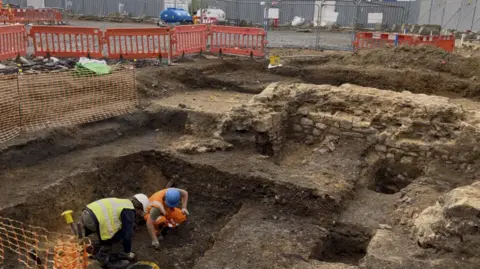
Also discovered during the excavations was evidence of the city's medieval Shambles and Drapery, a 15th Century market hall that once housed butchers, drapers, shoemakers and other trades.
The remains of a building called Gainsborough Chamber, a 16th Century civic building with its own dungeon, were also unearthed.
According to a book about medieval Leicester, written by historian Charles Billson, one of the prisoners interned in the dungeon in 1533 wrote: "Master Mayor sent me forthwith to a most vile prison called the Gaynsborrow, then offered to put gives and fetters upon my legs and so to lye upon hard planks without bed or straw and without company or comfort."
The archaeologists said they worked in narrow trenches, following the routes of drainage and electrical services required for the new market square, and found hundreds of postholes, traces of former market stalls, and several compact pebble surfaces.
Coins, keys, pottery shards, glass bottles, animal bones and a leather shoe were also found.

Dr Gavin Speed, who managed the excavation, previously described the site as "an archaeological cake".
"Whilst we know a great deal about other parts of Roman and medieval Leicester, this central area had remained largely untouched beneath centuries of redevelopment," he said.
"This excavation has allowed us, for the first time, to understand how this part of the town developed from the Roman period onward.
"We have uncovered Roman buildings, early medieval deposits, and the earliest phases of the medieval market - all stacked one above the other.
"To stand in the middle of the city and peel back nearly two millennia of history has been remarkable."
Speed added: "Our work in the field is now largely complete, but the next stage is just as important.
"The finds and records require detailed analysis if we are to fully understand what we have discovered.
"These results will be published in due course, and we hope that many of the most significant finds will ultimately be made available for the public to see."
 Leicester City Council
City mayor Sir Peter Soulsby said: "It's been extraordinary to watch the archaeologists reveal evidence of thousands of years of human activity in the heart of Leicester.
"We knew that the market was located in what would have been the south-east corner of Roman Leicester, but the discoveries that ULAS has made have surpassed our expectations.
"The analysis of their findings will help chart the evolution of Leicester's market place, from the Roman settlement to the post‑medieval town, shedding new light on an area of the city that has remained largely unexplored.
"Now that the archaeologists are completing their fieldwork, it's time for us to look ahead to the next phase in this site's long and fascinating history."
The council has said it hopes to have the new market square completed by the end of 2026.
Listen to BBC Radio Leicester on Sounds and follow BBC Leicester on Facebook, on X, or on Instagram. Send your story ideas to eastmidsnews@bbc.co.uk or via WhatsApp on 0808 100 2210.
