'Midwives didn't listen, now my child lives with the consequences'

 BBC
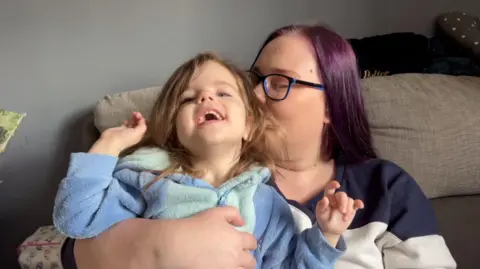
BBC"I attended A&E multiple times complaining of pain, tachycardia (increased heart rate), sickness - I couldn't keep anything down...but they didn't listen."
Angel-Kay Mason fell pregnant with her daughter in June 2022 aged 19.
Due to a family history of complex pregnancies, she says she was deemed to be high-risk but says she was not referred to a consultant and did not receive any extra scans.
Despite repeated attempts to report a range of symptoms, including bleeding and abdominal cramps between 16 and 26 weeks gestation, Angel-Kay says she felt "unheard and mocked" by midwives in the Maternity Assessment Unit at the John Radcliffe Hospital in Oxford.
"It was the standard 'go home, take a bath, this is your first pregnancy, you might not know how it feels...', it got to the stage where I was walking down the road and my heart rate was 240 (bpm) and I literally thought I was dying," she says.
Warning: This story contains details some may find distressing.
At 26 weeks, Angel-Kay says she was attached to a foetal heart monitor, she had not felt much movement and staff were concerned. Less than 20 minutes later she says she was rushed into theatre for an emergency caesarean section.
"I was given a form before I'd even had any of the cannulas put in or moved to the surgical room and it was a tick box form to decide what would happen to Aria's remains, it was almost like they already thought she was dead," she explained.
 Angel-Kay Mason
Angel-Kay's medical notes stated her amniotic fluid was green and her uterus was warm which she has been told are signs of an infection.
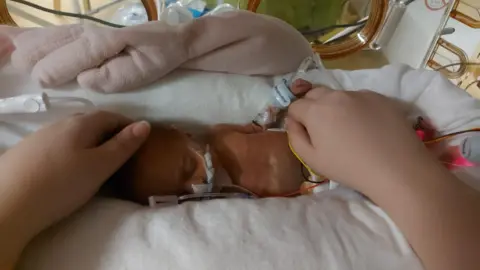
In the following days, baby Aria had to be intubated after her heart stopped, she turned septic and suffered a bleed on her brain.
She spent several months in the Neonatal Intensive Care Unit.
Professor Andrew Brent, chief medical officer at Oxford University Hospitals (OUH) Trust, said: "We have heard Angel-Kay's story and we are very sorry for what was clearly a very traumatic experience.
"We would like to ask Angel-Kay to get in touch with us directly, so we can fully understand the concerns she raises and offer a full investigation."
Now aged three, Aria suffers from multiple health conditions including cerebral palsy, epilepsy, global development delay and difficulty swallowing.
She has had a shunt inserted into her brain to drain excess fluid and may require a high-risk operation in the future.
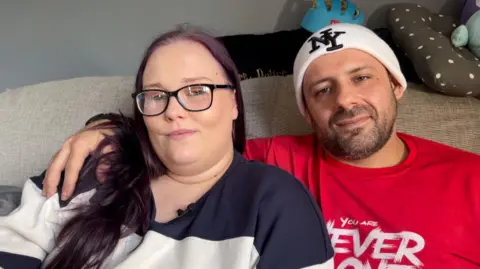
Angel-Kay and her husband Marley say routine scans showed Aria was healthy, they believe the infection during pregnancy led to their daughter's health issues.
"If they'd have picked up on the infection and I'd been given antibiotics it could have been a completely different story and now we have to live with that every single day, she has to live with that every single day," she said.
The couple, from Oxford, say they plan to take legal action against OUH.
Before Christmas, Angel-Kay was one of several Oxfordshire mothers who met with Baroness Amos who is leading the National Maternity and Neonatal Investigation.
The rapid review is assessing 12 hospital trusts, including OUH.
She previously said she was "shocked" by the scale of unacceptable treatment women and families receive across the country.
Her interim findings, published on Thursday, make clear the system is not working for women, babies, families or staff.
It highlights widespread racism and discrimination, poor quality estates, lack of capacity, workforce challenges and a poor response when things go wrong.
Baroness Amos said: "I would like to thank all of the women and families who have come forward to share their experience of maternity and neonatal care with me and with the investigation.
"I am acutely aware that recounting experiences of harm and bereavement is traumatic and emotionally draining, so I am enormously grateful to everyone who has been in touch with us."
Baroness Amos' Call for Evidence has already received more than 8,000 responses and remains open until 17 March.
'Institutional defensiveness'
Rebecca Matthews, co-founder of Families Failed by OUH which represents 750 families, agreed with the findings but said they did not go far enough.
"Our main concerns at Oxford go deeper than Baroness Amos' report... we are concerned about the lack of accountability, we're really concerned about the institutional defensiveness and this toxic culture at OUH which is definitely a top down culture," she said.
The campaign group is calling for a judge-led public inquiry to get to the bottom of what they describe as "unique and really seriously concerning issues".
Layla Moran, Oxford West and Abingdon MP and Chair of the Commons Health & Social Care Committee, said:" The findings in this report are sadly all too familiar, but seeing all the issues outlined side-by-side underlines the challenge to government in turning this around at a national and systemic level."
In a statement, Simon Crowther, interim chief executive officer at OUH, said: "We would like to thank the families and staff members who have spoken honestly and openly to Baroness Amos and her team.
"We are listening carefully to all feedback, and it is already helping us to make improvements and to identify areas of good practice we can build upon.
"The final report will be important in informing improvements in maternity and neonatal services at Oxford University Hospitals and across the country."
Baroness Amos will publish one set of national recommendations in the spring.
Health Secretary Wes Streeting said he will shortly launch and chair a new National Maternity and Neonatal Taskforce to develop a new national action plan based on Baroness Amos's findings.
"Action on maternity and neonatal care cannot wait... which is why this government has recruited over 800 more midwives, is investing over £140 million to address critical safety risks on the maternity estate, and is rolling out guidance to tackle the leading causes of maternal death," he said.
- If you have been affected by any of the issues raised in this story, information and support can be found at the BBC's Action Line.
Do you have more information about this story?
You can reach Katharine directly and securely through encrypted messaging app Signal on: +44 7860408649, by email at katharine.dacosta@bbc.co.uk, or her Instagram account
You can follow BBC Oxfordshire on Facebook, X, or Instagram.
