Is it right to call Brabazon project a 'new town'?

 YTL Arena Bristol
The government has revealed its list of potential sites that could be developed as part of its scheme to deliver a wave of new towns across England.
The promise of a "new generation" of new towns was included in Labour's last election manifesto.
Out of more than 100 locations put forward across England, seven areas were named last week - including Brabazon on the outskirts of Bristol.
But local Conservative councillor Liz Brennan said: "This development has been planned, approved and under construction for almost a decade. There is nothing 'new' about Brabazon."
The government's new towns, according to Housing Secretary Steve Reed, will be "whole communities with homes, jobs, transport links and green spaces designed together".
In Bristol, plans for Brabazon have been in the pipeline for more than seven years.
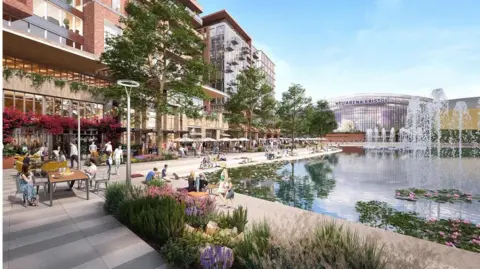
Costing about £2bn, the development is being built on brownfield land on the Bristol and South Gloucestershire border.
Along with 6,500 new homes it will also boast a 15-acre park, the city's long-awaited 20,000-capacity concert arena, and three schools.
But Brennan, leader of the Conservative group on South Gloucestershire Council, said although she was "delighted" by the progress it was the previous Tory administration in South Gloucestershire that had been "instrumental in developing Brabazon".
"To present it now as a newly identified solution risks misleading residents and overstating the government's role in progress," she said.
When is a new town not a new town?
The government's aim for each "new town" is to have at least 10,000 homes, contributing towards Labour's 1.5 million five-year housebuilding target.
But according to the Royal Town Planning Institute (RTPI), "most" of the government's new towns are not actually new.
"They are largely large-scale urban extensions - for existing settlements," a spokesman said.
"They are also largely ongoing developments – i.e. they are not 'new' but have [been] planned for a long time, or construction has already begun."
Despite not being "new towns" in the classical sense, the association said they were "still very significant".
"They do all share some significant characteristics with 'classic' new towns, however," they said,
"They represent large-scale development - if not as large-scale as the post-war new towns."
 MetroWest
From the 1940s to the 1970s a series of new towns were built across the UK.
The concept was launched by the post-war Labour government to tackle overcrowding in London and other big cities, with 32 being built, including Milton Keynes, Stevenage and Welwyn Garden City.
But the policy stalled in the 1970s, amid criticism of poor quality housing and transport links.
In a bid to prevent home ownership being "a distant dream", Prime Minister Sir Keir Starmer is now emulating the post-war government with what Labour has described as "the largest housebuilding programme since the post-war era".
Housing Secretary Steve Reed has previously said funding set aside for the new towns would only be allocated "when we know exactly what we want to build and where".
The RTPI, said although Brabazon "doesn't appear to be a new town in the classic, post-war sense" it "could be a real opportunity if planned in a way that learns from best practice around the world".
While Brennan said residents will expect that the Brabazon announcement will bring "tangible benefits, not just headlines".
"We will - hold regional leaders to account to ensure that this designation delivers real outcomes for our communities, rather than simply repackaging what is already underway," she said.
The BBC has approached the government for comment.
Follow BBC Bristol on Facebook, X and Instagram. Send your story ideas to us on email or via WhatsApp on 0800 313 4630.
