Two women, two different continents - but they've the same problem with their farms

 BBC
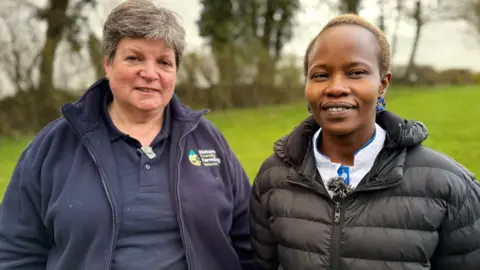
BBCJackline Mugoboka farms a small area in rural Rwanda. Louise Skelly is a sheep farmer in County Down.
Very different worlds, but both are experiencing the effects of climate change.
The two women have met and exchanged stories of extreme weather, along with the similarities and differences between farming in Rwanda and Northern Ireland.
Mugoboka grows bananas, beans and tomatoes on her one-hectare (2.5 acre) farm in Rwanda.
Women make up 90% of Rwanda's farmers
Although tiny by Northern Ireland standards, it is more than twice the size of the average Rwandan farm.
The country is still recovering from catastrophic floods and landslides in 2023.
Mugoboka, who visited farms on both sides of the Irish border during a visit to the island, said climate change was having a "profound" effect on the women who make up almost 90% of Rwanda's farmers.
"This has given them a workload - they are the ones that go for firewood, fetching water, doing all the farming work.
"So with this climate change crisis, it's really profound to them.
"They are losing everything."
A shared experience
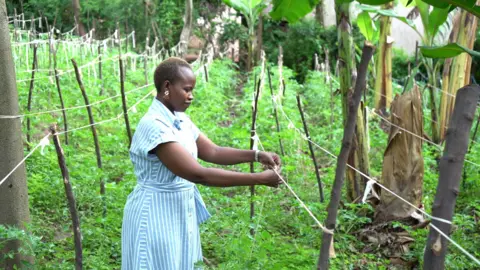
Mugoboka works with the Irish charity Trocaire and spent a day at a farm in Shanaghan Hill, near Katesbridge on the River Bann.
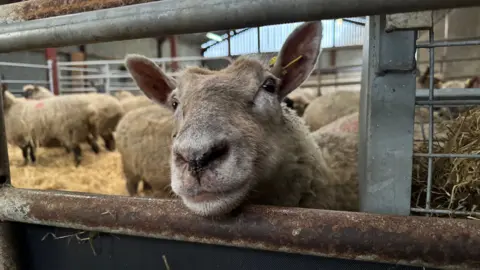
It is where Skelly has lived for 44 years. She rears sheep, and lambing season is just about to get under way.
Skelly said finding out that women in other parts of the world were facing extremes like having their homes and crops washed away was "a big lesson" for her.
She has seen the impact of increasingly extreme weather on her farm over time.
"In the last 10 years, we've had more extremes of floods than we've ever had, and that's the thing that's most striking about it.
"So there's a lot of debate about climate change, but I can only tell you what I know.
"And it's pretty obvious to me that we are experiencing more extremes in our weather from the point of view of trying to run this farm."
Mugoboka, who works with Rwandan farmers to help them become more sustainable in the face of climate change, said she was "surprised" to hear that flooding has been an issue for farms in Northern Ireland.
"Learning that you've had flooding, I realised that no one is immune from climate shocks - only that maybe you have different coping strategies as we are just limited on that," she said.
"That's the only difference.
"Otherwise, we are all having these issues of climate change."
She added that Africa produces "just 4%" of greenhouse gas emissions, but is bearing the brunt because it does not "have the resources to be able to do adaptation and mitigation strategies" to ease the impacts.
Disease challenges
Both women agreed that a changing climate was causing diseases that added to the challenges of farming.
Mugoboka said farmers were dealing with outbreaks "out of nowhere".
Skelly said she was considering vaccinating her ewes and lambs against bluetongue virus - a disease spread by biting midges that had previously been confined to Africa.
But the disease was confirmed to have reached Northern Ireland in November.
Plumes of midges carrying the infection are thought to have travelled up the eastern Irish seaboard from England, where there have been almost 300 cases of the disease since July.
NI has 'amazing future'
Skelly showed Mugoboka the tree planting she has been doing to reduce the impact of flooding and to provide shade to her animals during hotter, drier summers.
Native trees like alder, spruce and rowan are interspersed with hawthorn shrubs.
Bird boxes to support local wildlife are set among the branches.
Mugoboka described meeting Skelly and seeing the work put into protecting the environment one her farm as "life-changing".
Skelly said both women, particularly as mothers, would not be farmers if they were not hopeful.
"I think Northern Ireland has an amazing future in family farms."
