New snow and ice warning for Friday and Saturday

 Reuters
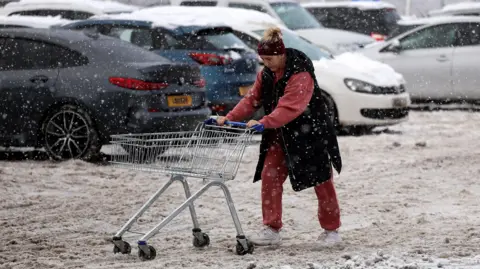
A new snow and ice warning has come into force across Northern Ireland for Friday evening and overnight into Saturday morning.
Icy conditions are expected to develop as clear spells allow temperatures widely to fall several degrees below freezing.
The Met Office yellow alert lasts from 17:00 GMT on Friday until 11:00 on Saturday.
Patches of ice are expected to form on roads and pavements, especially in untreated areas.
A scattering of wintry showers is also expected, with snow likely to fall on higher ground.
Hills above 200m could see between 1-3 cm of snow in a few areas.
The wintry conditions could lead to some travel disruption, as well as an increased risk of injuries from slips and falls.
Where in Northern Ireland gets the most snow?
 Cathal McNaughton/Reuters
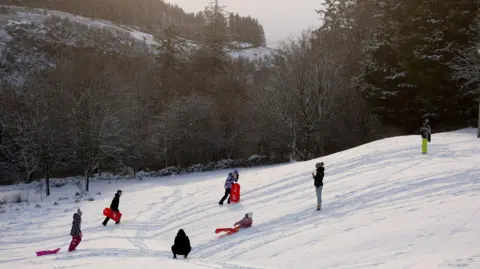
Northern Ireland's snowiest areas are its mountains, – Sperrins, Antrim Plateau, and Mournes – while coastal areas get very little snow in most years.
Snowfall increases with altitude so higher and more northerly areas tend to get more snow during the winter months.
The mountains can have over 35 days a year with sleet or snow falling, and over 30 days with snow lying.
Coastal and low-lying areas – especially near sea level – get little snow, usually fewer than 5 days a year with lying snow.
While snowfall varies hugely year to year, exceptional winters like 1962/63 and 1981/82 brought deep, long lasting snow event to coastal areas.
Cold Weather Payment
The Department for Communities said one Cold Weather Payment trigger has been reached in Katesbridge, County Down.
It relates to the period from 31 December until 6 January and covers the postcodes BT24, BT25, BT26, BT30, BT31, BT32, BT33 and BT34.
Households on certain benefits are entitled to the money when there is a prolonged period of below-zero temperatures.
Each cold weather payment is for a seven-day period and is worth £25.
The scheme runs between 1 November and 31 March each year.
What is the coldest it's ever been in Northern Ireland?
The lowest temperature ever recorded in NI was -18.7C at Castlederg in Tyrone during the big freeze of December 2010.
The lowest temperature ever recorded on the island of Ireland was -19.1C at Markree in Sligo in January 1881.
When does winter end?
The answer is simple.
It depends on which calendar you follow - ancient Celtic or Irish, meteorological, or astronomical.
The ancient Celtic calendar, also known as the Gaelic or Irish calendar, dates back centuries and is still followed by many in Ireland today.
It marks the winter season in November, December and January, with spring starting on 1 February - or St Brigid's Day.
The meteorological calendar is also grouped into three full months but the seasons begin a month later with December, January and March making up the winter season.
However, the astronomical calendar seasons are defined by two solstices and two equinoxes.
These are determined by Earth's tilt and the sun's position over the equator.
The winter season starts on the winter solstice, around 21 December, and ends on the spring equinox, around 20 March.
