Clarkson 'staggered' school dinner chicken from China is cheaper than UK's

 Dan Kitwood/Getty Images
Jeremy Clarkson has said it is "staggering" that chicken imported from as far as China is being served in some Welsh schools due to cost.
The TV presenter questioned why poultry from overseas was being served to schoolchildren instead of locally-produced chicken - and blamed the government for allowing imports that do not have to adhere to the same "expensive" farming standards.
Last month, statistics released by the Countryside Alliance, revealed some Welsh councils rely heavily on imported poultry products in school meals.
A spokesperson for the Welsh government, which sets policy on animal welfare, said it was "committed to increasing the use of locally-produced Welsh food in schools".
"How is it possible to ship a chicken all the way from Chiang Mai to Bridgend, and for it to arrive with a lower price tag than a chicken reared in some vowel-less village two miles down the road?" said Clarkson, writing in his column in the Sunday Times.
The former Top Gear star, whose exploits as a farmer in Clarkson's Farm have won him a new following, pointed to the "unbelievably strict and expensive-to-achieve standards on British farmers" while he said wholesalers imported meat and veg "that weren't grown or reared to anything like the same set of rules".
Branding the government "useless", Clarkson urged shoppers "to have a look at the labelling", hailing the standards assured by British foods carrying the Red Tractor logo.
"The government won't do anything to stop the import of food from farms that are riddled with disease and animal cruelty, but checking for that little tractor when you're out shopping means that you can," he wrote.
The Welsh Local Government Association (WLGA) said all chicken served in schools - whether sourced from the UK or overseas - had to meet strict UK food safety and hygiene standards.
Red Tractor is the UK's biggest certifier of farm products on supermarket shelves and assures approximately 95% of chicken farms in the UK - with farmers required to maintain high welfare standards, such as providing indoor-bred broiler chickens with natural light and sufficient space.
Clarkson said qualifying for Red Tractor accreditation every year was "as annoying as bumping into an electric fence", but acknowledged "jumping through these hoops does mean the farm is clean and efficient and well-run, and that the animals are properly looked after".
Responding to Clarkson's comments, a Red Tractor spokesperson said they suspected Clarkson was "referencing the overall mix of UK regulations which UK farmers must meet, in addition to the voluntary standards such as those set by Red Tractor".
"We fully support the sentiment of his message - we as a nation should support our food producers, who work hard and diligently to produce great food that is safe, traceable and is farmed with care."
'Support our producers'
In January, the Countryside Alliance released the findings of an investigation into the procurement of chicken products for school meals in Wales.
Councils in Wales procure food for school meals through formal public sector contracts.
Three out of 20 local authorities who responded to the Freedom of Information (FOI) request said more than 85% of chicken served in school meals in their area was sourced from countries outside the EU.
Farming and rural affairs are a devolved matter, meaning it is the Welsh government who sets out laws and policies on agricultural issues, including animal health and welfare.
Speaking previously, parents of schoolchildren were disappointed to learn chicken being served in some Welsh schools was not local.
Mum Leah Wright, whose child attends a school in Merthyr Tydfil where 99% of chicken served originated from outside the EU in the period analysed, said: "I assumed with something as important as school meals that everything would be locally sourced.
"Especially with the economy as it is now, keeping our economy stable and keeping everything local is really important - supporting local businesses."
A Welsh government spokesperson previously said the government was committed to increasing the use of locally-produced Welsh food in schools, and had "driven growth in local sourcing through Universal Primary Free School Meals and wider investments".
The government has stated its ambition to boost public sector spending on Welsh food by 50% by 2030, and is working with local authorities, producers and wholesalers to shorten supply chains and reduce food miles, the spokesperson added.
Who is responsible for food in schools?
Local authorities or school governing bodies are responsible for food provided in schools in Wales, and can choose their own menus and produce providing they remain compliant with government regulations and guidance.
Councils are also responsible for ensuring restaurants, retailers and other businesses involved in the supply of foods are compliant with food law, while checks at the point of import are mainly the responsibility of port health authorities.
Only specific countries and individual processing plants approved by the UK government and agreed by Welsh ministers are permitted to export poultry to England, Scotland and Wales.
Such establishments must demonstrate that they meet equivalent British hygiene and safety requirements.
All poultry imported into the UK must meet the safety and hygiene standards of the Food Standards Agency (FSA), an independent food safety watchdog.
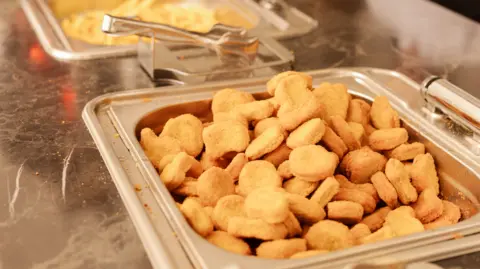 Getty Images
About a third of the chicken eaten in the UK is imported "so it's vital to know about welfare standards worldwide", said Kate Parkes, poultry specialist at the RSPCA.
Public sector food procurement is worth about £5bn a year in the UK. Parkes said governments could make a big difference to animal welfare, as well as supporting British farmers, "by insisting that all food procured for places like schools and hospitals is produced to higher-welfare standards".
Imports from countries such as the US and Mexico may have been raised under poorer conditions, said Parkes, citing higher stocking densities and the use of chlorine washes to reduce bacterial contamination on chicken carcasses.
But Parkes said more than 90% of chickens reared in the UK for meat were fast-growing breeds, which are prone to severe health issues.
She added that chicken from Thailand and Brazil had, historically, offered better welfare than much of the chicken produced in the UK.
She said: "These countries often have a lower-stocking density than is standard for UK farming, meaning the birds have more space."
The Department for Environment, Food and Rural Affairs (DEFRA) is responsible for managing animal health risks and animal welfare in the UK.
'Not just about price'
"At a time when Welsh farmers are producing high-quality food to world-leading standards, public bodies should be backing local producers, not overlooking them," said Ian Rickman, president of the Farmers' Union of Wales (FUW).
Rickman insisted, with the right approach from government and councils, more locally-produced food could, and should, be ending up on the plates of local schoolchildren.
He said the FUW was calling on the incoming Senedd and Welsh government "to deliver a Welsh public procurement programme that genuinely shortens supply chains, bolsters circular economies and promotes all Welsh produce throughout the public and food service sectors".
Procurement decisions "shouldn't be driven by the lowest price alone" he added.
An NFU Cymru spokesperson said it was asking all parties to make a commitment to increasing procurement levels of Welsh produce, ahead of the Senedd elections in May.
"Welsh farmers are proud of the standards to which they produce the nation's food, observing environmental, production and animal health and welfare standards that are amongst the highest anywhere in the world," they said.
They said it was "imperative that food imported into the UK meets those same high standards".
