I might not get uni Covid compensation - but I'm claiming it out of principle

 Riki Auton
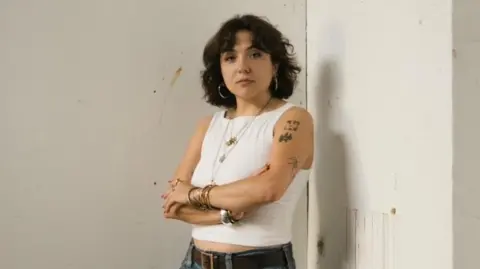
After years of studying, Riki Auton was beyond excited to start her fine art degree at University of the Arts London.
But when she began life as a student in 2019, she could not have known how different her time at university would be to the one she imagined.
Most hands-on elements of her degree, including art studio work, were ultimately lost to the lockdowns of Covid.
As a result, she says, students on her course "didn't receive the educational experience we paid for".
The 27-year-old, from Oxford, is among thousands of Covid students to have joined the Student Group Claim, seeking compensation from their universities because of their experiences during the pandemic.
Now, 36 institutions are subject to legal action after receiving pre-action letters from lawyers warning that students intend to seek damages for learning which they claim they paid for, but did not actually receive.
Part of the issue, students say, was the lack of access to the resources which would normally have been available.
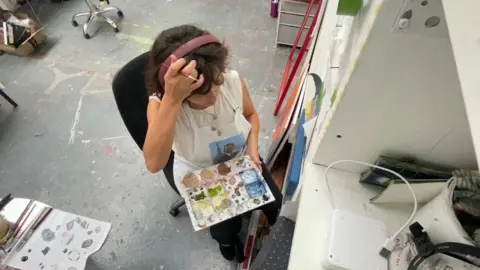
Although some academic literature could be accessed online, Riki said a lot of her art resources, including exhibition catalogues and image archives, were not digitalised in the same way that traditional literature was, which made it "completely inaccessible" during lockdowns.
The university's "materials library", which had different books, as well as textiles and fabrics, was also closed, meaning students' projects had to change drastically.
"It's obviously not something that you can replicate online, it reduces the spontaneity and depth of research that you can do," Riki said.
 Riki Auton
Her degree also relied on specialist equipment,such as cameras and lighting, which could usually be rented through the university but was also out-of-bounds during Covid.
Riki said students were instead encouraged to make digital art, often requiring expensive software which needed a good laptop to run on, without access to university computers.
The software was discounted to make it easier for students to purchase, Riki said, but it was not reimbursed.
For some students, even those digital resources weren't accessible.
"I had a friend of mine that spent lockdown with her grandparents, and they had limited WiFi, and the only material she could access was a biro pen and lined paper," Riki said.
"Being told that you should use that as a scenario to create, that's not an art education."
 Riki Auton
Even when universities began to open up through social distancing, Riki said she still struggled to get access to art facilities because slots had to be allocated to students.
She said students were also unable to buy university-discounted materials, with the on-campus shops closed during lockdowns, which meant purchasing them independently at full price "at a time when people were already facing financial strain".
"It's just really sad to see people scale down their talent and ambition and opportunity just based on cost, rather than their creative intention," she said.
Riki said she was grateful for the support of her tutors, but also found it difficult after leaving university to get ahead in a congested job market.
"I left university and was trying to apply for jobs against people that have PhDs, and they were going for the same entry-level roles as I was, because they had been let go during Covid," she said.
Altogether, she believes she is owed compensation for what she missed out on.
"If you go to a restaurant and you order mains and sides, and only the sides come, you're not going to be expected to pay for something that you asked for and didn't get," she said.
A spokesperson for the University of the Arts London said they would not comment on individual claims or circumstances, but recognised that Covid "created significant disruption for our students".
The university had to close buildings and limit access to campuses in line with the law and public health guidance at the time, they said, adding that the university "focused on delivering teaching and providing support to our community of students".
Buildings and facilities were reopened once it was safe to do so, they said, while the university's complaints process was available for anyone to raise concerns.
"The health and safety of students and staff remained our priority throughout," they said.
"Adjustments made during the pandemic, including online delivery, were implemented to maintain academic continuity and enable students to complete their studies and progress, or graduate, as planned."
'If I wasn't a resilient person, I would have given up'
 Faith Brynel Pomell
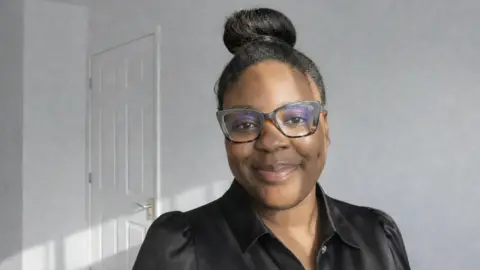
Faith Brynel Pomell, who has also joined the Student Group Claim, studied politics at King's College London between 2020 and 2023.
Just two weeks after she moved into rental accommodation in London to start her first year at university, Faith was suddenly told she would have to move back to her home city of Birmingham as lockdown began.
She says the standard of teaching during the pandemic was not up to the quality she expected from the university.
"We just lost that rapport with lecturers when we were meeting on Teams, not in person," she said.
"I think online study can work for some people, but for me, I wanted that in-person study."
She said she found seminars difficult, as many students didn't engage in academic debates or put their cameras on.
"I'd be basically talking to myself because they weren't responding," she said.
Moving back to London in her second year, Faith said she struggled to adapt to a brand new city and felt "isolated".
"If I wasn't a resilient person, I would have given up," she said.
She ended up graduating with a 2:1, but believes the first-year disruption impacted her overall grade, saying she had to do a lot of self-study to get her good marks.
BBC News approached King's College London for a response, but the university declined to comment.
Riki and Faith say they are both focused on what the claim represents, rather than the potential compensation itself.
"I have come to accept that I'm probably not getting that money back, but I'm not taking part because of the money, I'm taking part because of the principle," Riki said.
Faith, meanwhile, said she would like an acknowledgement from her university about the academic impact which she and thousands of other students suffered during Covid.
The universities to have received pre-action letters will now have a chance to respond to the lawyers for the Student Group Claim before any further proceedings can begin.
Additional reporting by Paula Campbell
