Councillors approve student flats after tight vote

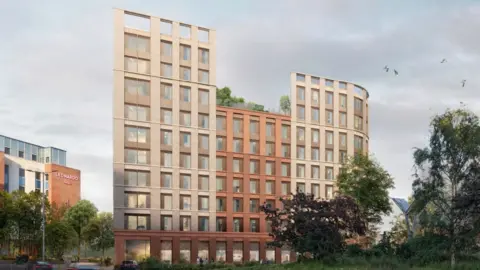 Chapman Taylor/Zinc/Exeter City Council
A tightly fought vote has cleared the way for a 10‑storey block of almost 300 student flats in a city, despite some concerns the building will loom over a neighbourhood.
Councillors approved the plan for the Western Way site in Exeter, Devon, which currently houses the city's JobCentre.
Manchester-based developer Zinc Real Estate will demolish Clarendon House and replace it with purpose-built rooms for Exeter University students. The company had first suggested a much taller, 20‑storey tower in 2023, but scaled it back after criticism.
Historic England expressed worries about the design but did not object formally.
Councillor Lynn Wetenhall told the city council's planning committee Exeter already had enough student blocks and said falling student numbers meant the land should become homes for local people instead.
She said councillors should be brave enough to push back on the idea that the site only suited students and added it would work for high-quality flats, according to the Local Democracy Reporting Service (LDRS).
Keith Lewis, from the Exeter Civic Society, warned the scheme was overbearing and said its scale and massing would create harm to the city.
He questioned what public benefit the block would offer.
But Matthew Rowe, from Rok Planning, said more than 10,000 students were living in shared houses and argued more purpose-built rooms would free up family homes.
He said any harm was at the lowest degree and should be balanced against a substantial package of public benefits.
The council's strategic director for place, Ian Collinson, backed the location. He told members it was one of the best possible sites for student accommodation and described it as a gateway spot in need of a gateway building.
Councillor Michael Mitchell said the density and massing were too much and stressed the building would stand for generations.
A move to defer the decision failed by one vote. Permission was granted by six votes to three, with one abstention.
Follow BBC Devon on X, Facebook and Instagram. Send your story ideas to spotlight@bbc.co.uk.
