Businesses call to be included in any pub rates backtrack

 Getty Images
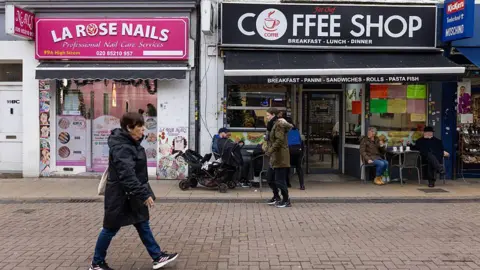
High Street shops, pharmacies and music venues have called on Chancellor Rachel Reeves to axe looming increases to business rates for them as well as pubs.
The government is expected to announce a climbdown on rises to business rates bills faced by pubs in England in the coming days.
Landlords and pub owners have been fiercely critical of the impending hikes, with more than 1,000 pubs banning Labour MPs from their premises.
But other lobby groups and backbench MPs have urged the government to widen the relief, saying many other kinds of businesses will not be able to pay the higher costs.
Anna Turley, chair of the Labour Party, told the BBC's Today programme that the government would keep the conversation with firms open.
"Where businesses are telling us they are struggling and they need more support it is absolutely right that the chancellor talks to them, engages with the sector and looks at what we can do to assist them," she said.
Business rates will increase sharply over the next three years as Covid-era support is phased out and property values are adjusted to reflect a return to normal business, post-pandemic.
Despite additional support announced in November's Budget, businesses say they will struggle to pay the higher bills.
Following pressure from the hospitality sector, the government has indicated it is preparing to make further changes.
However, the BBC understands the climbdown will apply only to pubs and not the whole sector.
The British Independent Retailers Association (Bira) questioned why its members -– which include High Street shops, restaurants and cafes — would not be given the same relief.
Its chief executive Andrew Goodacre said independent retailers "face exactly the same challenges as pubs but have been left out of discussions about additional support".
"Perhaps independent retailers need to follow the pubs' example and start banning MPs from their premises too," he said.
Surinder Arora, who operates a number of hotels in the UK, said a potential carve-out only for pubs was "not right or fair".
The chief executive of the Arora Group told the BBC that the business rates bill for just one of his hotels increased by £12.4m after discounts were scaled back.
"The new numbers are eye-watering," he said, warning that the higher costs will be passed on to his customers and "belt-tightening" was inevitable.
While Arora said he supported the chancellor's growth ambitions, higher taxes mean "instead of expansion, we could be going the other way".
'Punishment beatings'
 Michael Van Clarke
Michael Van Clarke, founder of a high-end London hair salon and haircare products brand, said the current business rates system was "dysfunctional" and should be changed.
"Most service-heavy business haven't yet recovered from Covid lockdowns," he said.
"[The rate rises are] really just the latest in a cascade of punishment beatings we have suffered for the last six or seven years."
The British Retail Consortium (BRC) said the current business rates system "is not fit for purpose".
Helen Dickinson, the BRC's chief executive, said: "This latest announcement looks like another sticking plaster on a broken system rather than the more fundamental reform required."
Jon Collins, chief executive of music venue body LIVE, said: "If the government is preparing a U-turn on business rates for pubs, it must not leave live events and arenas behind."
The National Pharmacy Association chief executive Henry Gregg said the sector could face a 140% increase in rates, while the lobby group for gyms, pools and leisure centres said those businesses faced potential rate increases of 60%.
"Failure to provide a business rates support package to gyms, pools and leisure centres will lead to higher prices, reduced services, redundancies and in some cases the loss of gyms from our communities," chief executive of ukactive Huw Edwards said.
What are business rates?
Business rates are a tax based on the "rateable value" of a firm's premises, which is reassessed every five years.
The last evaluation in 2021 reflected the impact of Covid on business activity, and the latest one - which will be used to calculate bills from April this year - show significantly higher values as result.
To help ease the impact of higher rates Reeves used the Budget to shift the bulk of the rises away from smaller and onto larger businesses, arguing it would support the High Street and ensure online firms with big warehouses paid more.
The final business rate bill is calculated by multiplying a premise's value by a fixed number known as "the multiplier". From April, this will be set much lower for smaller business in the retail, hospitality and leisure sector, than it will be for larger firms and those in other sectors.
Businesses in those sectors enjoyed a discount on their rates during and immediately after the pandemic. The initial 75% discount has been reduced to 40% this financial year, and will end completely in April.
In its place, the government will provide transitional relief of £4.3bn, allowing the bill increases to be phased in over three years.
Some of those lobby group concerns were echoed by MPs.
"Venues, clubs and cinemas up and down the country are already struggling for survival," Conservative MP Dame Caroline Dinenage wrote to the chancellor on Thursday.
She said the planned rates reforms risk "pushing many over the edge".
Reeves said earlier this week that the government had reduced the rate of tax on pubs and hospitality, but the Independent Valuation Office increased what they saw as the value of those properties.
"Now we're working with the sector to look at the implications of a range of policies and looking at planning and licensing," she said in an interview with Good Morning Britain.
"I want to support our pubs; I want to support our High Streets. That's why we made the change to the rates. But I recognise that many paths are still struggling and we're working with them."
