How do community diagnostic centres help the NHS?

 Ellen Knight/BBC
On an industrial estate, just off the M54, is the Hollinswood House Community Diagnostic Centre (CDC) - a somewhat nondescript building that plays a vital role in tackling NHS waiting times.
It opened in October 2023, and since then 292,293 procedures have been carried out there - from CT scans, to blood tests, to cardio-respiratory appointments.
Shrewsbury and Telford Hospital NHS Trust has credited the site with helping reduce waiting times, as it takes the pressure off its main hospital sites and focuses purely on planned, non-emergency procedures.
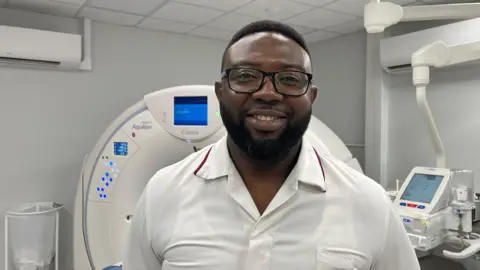
Richmond Bempah is a radiographer there, and said it "cuts time down significantly" for patients waiting to have a scan.
In the radiography department where Bempah works, CT scans, MRIs, non-obstetric ultrasounds, and X-rays are carried out.
The team there even see same-day appointments for chest X-rays, when patients are referred by their GP earlier in the day.
"It cuts down waiting times significantly", Bempah said, as patients are "instantly booked on" by their GP.
 Ellen Knight/BBC
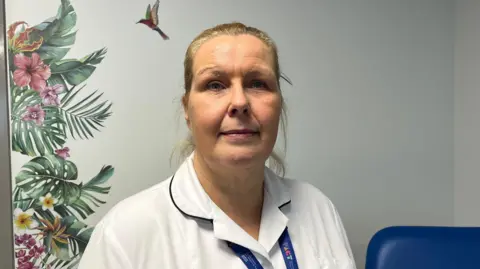
Through a set of double doors, the phlebotomy department is busy with blood tests, working from 08:00 until 17:00 and seeing patients "every minute".
It is headed up by Heidi Van Duivenbooden, who estimated that "up to 400" tests were carried out every day.
"With the number of patients that we take in, I think we're helping take the pressure off," she said.
"People don't have to wait three to four weeks [for diagnosis], they get it within 48 hours here at the CDC."
 Ellen Knight/BBC
Robert Kendall, who was there for a routine blood test, said he was seen "within no time".
"I wouldn't say it's inconvenient," he said of coming to the CDC for a blood test.
"It's easy to park generally, so it's not a problem at all."
The availability of parking spaces is very much at odds with the situation at both main hospitals, where major building work is going on.
'Exciting' cancer trial
Meanwhile, on the third floor, a groundbreaking cancer trial is well under way.
The Triomic trial, launched in December 2024, is a pioneering new way to diagnose colorectal cancers, which could reduce the need for time-consuming and invasive colonoscopies.
About 2,600 patients in Shropshire have taken part so far in the first-of-its-kind trial, and thanks to funding from medical technology company Origin Sciences, three clinic rooms have been built at the CDC.
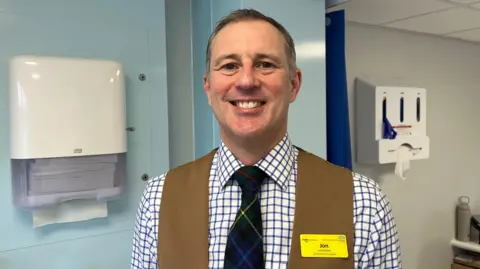
Consultant colorectal surgeon Mr Jon Lacy-Colson said the new rooms meant "we're now able to offer 150 [appointments] per week".
 Ellen Knight/BBC
This is a "massive improvement" for patients, Lacy-Colson said, as it meant they were finding out "much, much earlier whether or not they need to have further investigation".
The Triomic technology collects rectal mucus samples, which are then tested for abnormal cells and significant polyps.
Lacy-Colson explained that in the future, it could mean that "within a week of referral by their GP," patients would know whether or not they had cancer.
The consultant described it as "the biggest development in colorectal cancer diagnosis for a long, long time".
"It's really, really exciting that we've been able to lead on that here in Shropshire," he said.
 Ellen Knight/BBC
As the test is still being developed, patients with suspected cancer are still subject to a colonoscopy to confirm whether they have the disease.
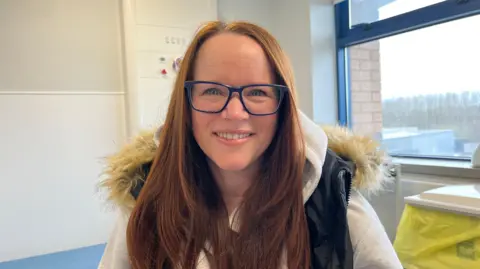
Michelle Kinder is one of those patients - the 48-year-old was diagnosed with colorectal cancer in November and took part in the Triomic trial.
She had an operation in December and by January was declared cancer-free.
Kinder, who has five children, said she was "very impressed with how quickly I've been seen [by medics]".
"I was more than happy to help out [with the trial] because it's such a worrying time for anybody," she said, adding that "if it means you can get the answers you need... then I'm happy to help anybody."
 Ellen Knight/BBC
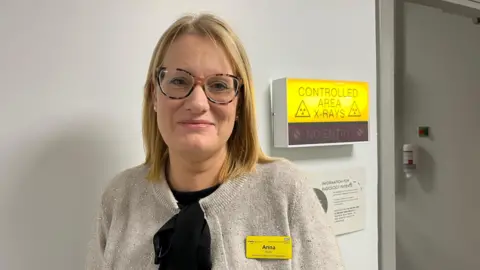
Anna Martin, the trust's divisional director of operations, said diagnostics were "the golden thread that run through everything we do in hospitals".
The CDC, she said, was "an addition to what we see at the hospitals," meaning there were "more appointments, and more scanning opportunities".
"It's all in all, a much better experience," she added.
"We have seen and done around 292,000 appointments and scans since we have opened," Martin said, adding that the diagnostic service was "absolutely key for us to run the hospitals and do well".
Follow BBC Shropshire on BBC Sounds, Facebook, X and Instagram.
