'New screening could have saved our baby's life'

 Supplied
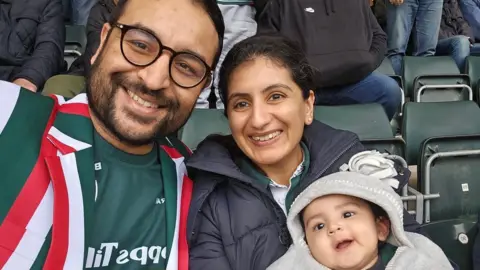
A couple whose son died from a rare genetic condition are encouraging others to take part in screening which they say could have saved his life.
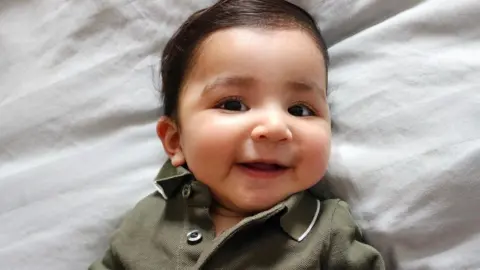
Priya and Abhishek Pancholi, from Leicester, had their son Aarav in September 2022 after a normal pregnancy without issue.
However, he was diagnosed with spinal muscular atrophy (SMA) at six months old and died shortly after his first birthday in December 2023.
The Generation Study, which is now available at Nottingham University Hospitals (NUH) NHS Trust, tests for more than 200 rare genetic conditions after birth. It is already offered at University Hospitals of Leicester (UHL) and University Hospitals of Derby and Burton trusts.
Aarav's parents said by the time of his diagnosis, he was too old to receive treatment, which can slow the progression of the disease.
When he was born, Priya and her partner were unaware they were carriers for SMA, which is not a condition checked for during routine baby blood tests.
She said she first noticed a problem with Aarav when he was roughly eight weeks old, as he was noticeably not putting on weight.
Priya said she was told "everything was fine" despite raising concerns to her GP multiple times.
 Supplied
Eventually, after a referral to a specialist, genetic testing revealed Aarav's diagnosis.
Priya said her reaction was of "absolute devastation".
"SMA is such a harsh diagnosis, and the outcomes are really poor, and because my husband and I both work in healthcare I think we had slightly more insight into what that diagnosis meant.
"From a parent point of view, as soon as you get that positive pregnancy test, you begin to dream - about everything that you want to give them, everything you want them to experience.
"So while you're also dealing with this really harsh diagnosis, what you're also doing as a parent is you're mourning the life you thought they would have," she said.
The genetic screening was not offered at UHL at the time of Aarav's birth but Priya believes he would still be alive today if it had been as it is done at birth.
"The late diagnosis meant most of his muscle movement was lost, and by which point it had severely affected his breathing muscles, which sadly that's the big one," she said.
Dr Neeta Lakhani, consultant clinical geneticist at UHL, said Leicester's hospitals had been offering the screening since January 2025.
'No family should suffer'
Lakhani supported Priya during the time of Aarav's diagnosis and his eventual death.
She said the trust's decision to sign up to the screening had been largely influenced by Aarav.
Priya is now also backing the rollout of the study at NUH, which began in December.
"No other family should suffer in the way that my son did, I wouldn't wish that upon anybody," she said.
The Generation Study is run by Genomics England in partnership with the NHS.
The opt-in screening checks for more than 200 rare genetic conditions using a small blood sample, usually taken from the umbilical cord shortly after birth.
It is a long-term research study which aims to find conditions early, and learn more about genes and health.
Participation is voluntary but officials from UHL and NUH say it has the potential to save lives and are encouraging parents to take part.
Follow BBC Leicester on Facebook, on X, or on Instagram. Send your story ideas to eastmidsnews@bbc.co.uk or via WhatsApp on 0808 100 2210.
