Mum sets up support group for rare brain condition

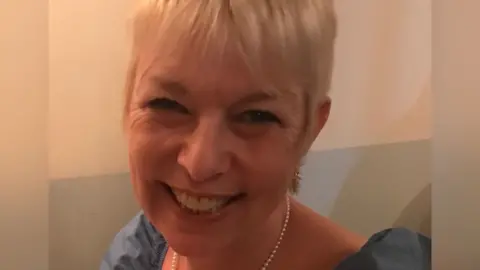 Julia Brannigan
A mum has set up a support group for people affected by a rare brain condition after her son was diagnosed earlier this year.
Julia Brannigan, from Guiseley, launched the group, with the help of the Ann Conroy Trust, to help those affected by Chiari malformation
She said it had been "very hard" as a parent to come to terms with her son's diagnosis and hoped the group - the first in the north of England - would allow people to "feel connected" and help raise awareness.
"I found it really helpful to be in a room where people were talking about it as their normality, because it's this rare neurological condition that nobody's heard of," she said.
"Even medical professionals, many of them just don't know about it and don't understand it," she added.
The Ann Conroy Trust currently only has operates support groups in Cornwall and the Isle of Wight, which inspired Mrs Brannigan to start her own.
"My main drive is about helping people affected by Chiari to feel connected and less isolated and raise awareness of the trust and the support and guidance and information and the research they do.
"I don't want people in the region who are touched by Chiari to feel alone."
The group first met in Leeds on 27 November, with eight people from across Yorkshire and Lancashire. The next is planned for 29 January.
'He's young, he's fit, he's bright'
According to the NHS, Chiari malformation is where the lower part of the brain pushes down into the spinal canal.
It is not considered life-threatening but decompression surgery, which reduces the symptoms, has risks.
Mrs Brannigan's son Joe, 24, first discovered he had symptoms of the condition when he developed numbness in his arm and hands.
Further tests and an MRI scan revealed he had Chiari Malformation and Syrinx/Syringomyelia - where a fluid-filled cavity called a syrinx develops in the spinal cord.
Mrs Brannigan said he had given up contact sport and weight lifting as a result and was now waiting to undergo brain surgery in February.
Jezz Wright, communications manager for the Ann Conroy Trust said living with Chiari malformation and Syringomyelia could be an "isolating journey".
He said: "Individuals frequently contend with debilitating challenges, including chronic severe headaches, neck pain, muscle weakness, sensory loss, and loss of mobility.
"These symptoms can severely disrupt everyday life, making everything from simple household tasks to maintaining regular employment a significant hurdle."
He said support groups were a vital lifeline for people with condition.
"They transform what can be a solitary struggle into a shared experience, providing a unique community where members are truly understood without needing to explain their symptoms."
Listen to highlights from West Yorkshire on BBC Sounds, catch up with the latest episode of Look North.
