I was in agony with mouth ulcers - it was tongue cancer

 BBC
BBCEarlier this year Margot Blair suffered from recurring mouth ulcers and tongue pain - eventually her tongue became swollen.
She endured increasingly severe pain, which radiated from her jaw, through her cheeks and up her head.
By July she was taking so many painkillers she felt physically sick, and she turned to a private consultant for help. He diagnosed tongue cancer.
Now Margot is raising awareness of the symptoms in the hope of encouraging others to seek medical advice if they feel something is not right.
The 62-year-old from Dumfries first experienced white lesions on her tongue in 2022, but a biopsy indicated nothing too concerning.
Two years later the mouth ulcers began and in May this year her tongue became swollen.
"By July it was an emergency because I was in so much pain," Margot told BBC Scotland News.
After trips to her dentist, she booked an appointment with a private oral maxillofacial consultant.
"When I went to see him, without biopsy, he took one look and diagnosed squamous cell carcinoma," she added.
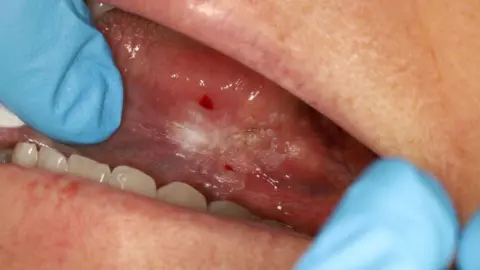
Within a couple of weeks, Margot began follow-up testing including MRI scans, CT scans and biopsies at Dumfries and Galloway Royal Infirmary
After having the initial cancer and lymph nodes removed at the Queen Elizabeth University Hospital in Glasgow, the pathology report showed the cancer had spread.
This meant a secondary surgery was required on Margot's tongue, as well as the removal of cancerous lymph nodes in her neck.
Her treatments have left her with a five inch scar on her neck, problems with her taste and speech difficulties.
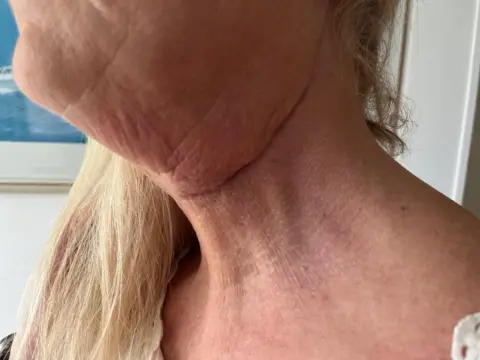
''My tongue feels salty all of the time. I have a foul taste in my mouth and even water tastes strange.
''I'm not comfortable on the phone and if I get excited or speak too quickly, I bite my tongue because it's still very swollen,'' Margot said.
Stage three cancer
The retired mother of one has now begun six weeks of intensive, targeted radiotherapy at the Beatson in Glasgow.
It was something Margot said she was desperate to avoid, but she understands is necessary to give her the best chance of survival.
"When I was first diagnosed, the cancer was a stage one," she said.
"Then it was stage two and now stage three. Your survival rates reduce dramatically. It went from 90% for surviving more than five years, to about 40%-45%."

Margot has had four molars removed ahead of her radiotherapy.
''The reason being that down the line if you needed to get extractions, it can be quite dangerous because of the effects of radiotherapy on your bone, which can cause a lot of other complications,' she said.'
She has also lost weight due to the pain she experiences whilst eating and difficulties swallowing.
''It is not something that comes naturally any more,'' she said.
Her surgeons have warned her that there is a possibility she may require a feeding tube if her weight drops too low during treatment.
''I will do everything in my power to prevent that from happening, but it is not easy when your mouth is so painful,'' she said.
Head and neck cancers make up just 4% of all cancer diagnoses, according to Public Health Scotland.
Early diagnosis and treatment is key to a good outcome.
Two of the main risk factors for developing mouth and oropharyngeal cancer are consuming alcohol and smoking, according to Cancer Research UK.
Margot is a non-smoker who goes to the gym fives times a week, and drinks very little alcohol. She hopes her lifestyle choices will help her to fight the disease.
Now her focus is on raising awareness of mouth cancer. Margot is sharing her journey by posting regular videos on her social media page, to help demystify some of the treatments and procedures.
"If you have something in your mouth like an ulcer for two weeks, three weeks at a maximum, you must seek professional help," Margot said.
What are the early signs of oral cancer?
According to the National Institute for Health and Care Excellence, early signs and symptoms of oral cancer include:
- unexplained ulcers or swelling and/or thickening for more than three weeks
- a persistent and unexplained lump in the head or neck
- a lump on the lip or in the mouth
- a red patch, or a red and white patch, in the mouth
- persistent (not intermittent) hoarseness lasting for more than three weeks
- persistent pain in the throat or pain on swallowing lasting for more than three weeks
Cancer Research UK Health Information Manager, Sophie Brooks, said: "In the UK, both dentists and GPs can refer you for further tests if needed, so you can choose the option that works best for you.
"And if your symptoms continue, get worse, or you notice any other changes that aren't normal for you, make another appointment to get checked again.
"In most cases it won't be cancer, but if it is, spotting it early means treatment is more likely to be successful."
If you or someone you know has been affected by cancer, a list of organisations which may be able to help is available via BBC Action Line.
