Ambulance trust 'cannot improve delays alone'

 BBC
BBCEast Midlands Ambulance Service (EMAS) has said it cannot improve alone after recording the worst average response times to the most serious calls in 2025.
NHS data shows category one patients in the region - the most critically ill - waited an average of nine minutes and 12 seconds for an ambulance - longer than in any other region in England.
EMAS also had the slowest average response time to category two calls - calls which are emergencies but not immediately critical - last year.
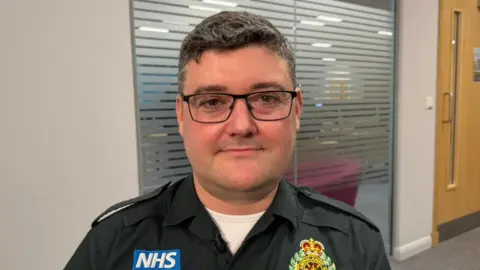
Dr Steven Dykes, the service's clinical director, said the problems facing EMAS required "whole-system improvements" as well the help of the public.
Dykes said a growing and ageing population - more patients with frailty and more long-term complex needs - meant EMAS needed to change how it delivered its services.
However, he accepted EMAS "must do better".
"We absolutely care, we are absolutely doing everything we can to improve the system.
"It is a complex situation - this is multiple agencies coming together to resolve the issue," he said.
Only the North East Ambulance Service in England met the seven-minute standard for average response times to category one calls last year.
NHS England sets the standard ambulance response times that all trusts should be aiming for.
According to the NHS, none of England's ambulance services reached the standard category two call response time of 18 minutes, and have not done so for several years.
'Thousands of hours lost'
Despite EMAS's slowest category one response of nine minutes and 12 seconds, it had improved by 36 seconds from 2024, and its 44 minutes and 19 seconds average response time for category two calls was an improvement on 2024, when patients waited longer than one hour.
Dykes said EMAS was losing "thousands of hours a year of ambulance time" to handover delays at hospitals.
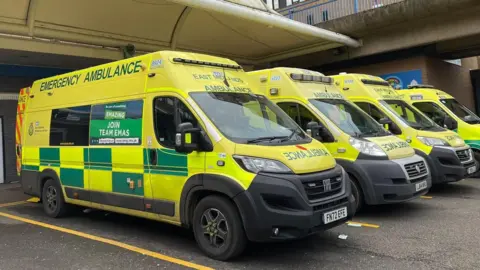
Ambulances queuing outside hospitals are not an unfamiliar sight, however Dykes said this was "only the most visible part of the delays" on the system.
He said there were also delays in contacting primary, community and social care, when it came to discharging patients.
In a bid to reduce the number of ambulances sent out unnecessarily, Dykes said EMAS had invested in 50 extra clinicians in its control room since the summer.
"Not necessarily every patient that phones 999 needs a blue light ambulance to hospital, but they do need access to expert clinical care and that can be done remotely," he said.
Dykes said those clinicians were able to identify whether patients' needs could be met without them being transported to a hospital.
"Now, one in five patients is managed without sending an ambulance and a referral back into their own primary care and community care needs," he added.
But improving the flow of patients, Dykes said, was also on the public.
On one of the service's busiest days this month, EMAS said it received more than 4,000 calls, but added about 2,500 did not need an ambulance.
"We can't do this as an NHS alone or social care alone - we need to work as a population as to how to better serve our frail elderly relatives and how we get them back home or back into care homes so that we can free up our hospitals," he said.
The government is proposing to take the pressure off hospitals as part of its 10-year plan for the NHS.
Under the plan, the government aims to shift work out of overcrowded hospitals and into local hubs staffed by GPs, nurses, pharmacists, mental health specialists and other medics.
Follow BBC Nottingham on Facebook, on X, or on Instagram. Send your story ideas to eastmidsnews@bbc.co.uk or via WhatsApp on 0808 100 2210.
