The home care team keeping patients out of hospital

 BBC
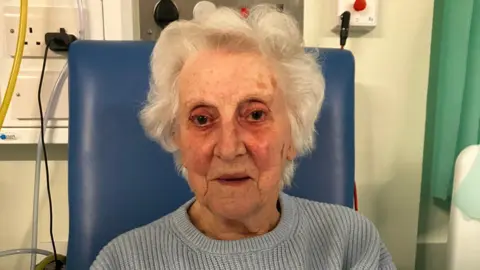
BBCPat Ellis is 77 and has chronic obstructive pulmonary disease (COPD).
She recently had a stay in hospital after an asthma attack but has returned home.
"I've got my little dog here and my family so I'm much better off at home," she said.
She counts herself lucky because she is one of a growing number of patients being kept out of hospital by a dedicated on-the-road team.
Urgent community response (UCR) visits deliver face-to-face care tailored to individual needs - and it is on the rise.
It is what is known as "hospital at home".
Last year, more than 3,500 patients in north Hampshire were cared for in this way - 85% were kept out of hospital.
In 2024, Hampshire and Isle of Wight Healthcare Trust delivered 18,086 in-person appointments.
But demand far exceeds its capacity.
Sue Norman, the the advanced clinical practitioner in the UCR team, said: "Every day we have to turn referrals down - we started with eight and our teams are now over 40.
"So that gives you an idea of the rapid growth that we've had, we just need more. It's a hugely needed service".
The UCR accepts referrals from GPs, Hampshire hospitals, ambulance services, families, and patients themselves.
It helps prevent unnecessary hospital admissions and keeps people safe at home and away from the emergency departments reducing system-wide pressures.
Hampshire Hospitals NHS Foundation Trust has about 180 patients in beds that are medically well enough to go home.
It is what the NHS calls NCTR - or No Criteria to Reside.
A visit to the Royal Hampshire County Hospital's Wickham Ward reveals the daily challenge to free up beds.
In one bay 3 out of 4 patients are waiting to leave – but they need support at home in order to safely return.
Irene Truss is 97 and it is her first ever stay in hospital after falling at home.
"I have been told that I need some support now, I need a bit of support in the mornings to get up and shower and get dressed," she said.
Tracy Whale, the divisional chief nurse for medicine at Hampshire Hospitals Foundation Trust, said: "We know that an acute hospital is not the right place for a lot of our patients that need time to recover, people need to be at home.
"We know that people are less active when they are in a hospital bed, and that can lead to deconditioning, which means things like mobility is reduced, appetite is reduced and ultimately people become more frail than they were prior to coming into hospital."
Like all trusts, Hampshire Hospitals is urging people to think carefully about whether patients need to come into accident and emergency and to think about where else they can access support in the community.
If you are admitted to hospital the advice is to have a plan for discharge early to help free up beds.
The approximate number of patients who no longer need hospital level care but are still in hospital beds has been supplied by the NHS:
- Hampshire Hospitals: 180
- Southampton General: 240
- Bournemouth and Poole: 250
- Queen Alexandra Hospital: 270
- St Mary's Hospital: 76
It is in response to hospital pressures on beds that Hampshire and Isle of Wight Healthcare Trust's Hospital at Home team is expanding.
It has grown by140%, increasing capacity from 20 beds to 48.
This means more patients can receive hospital-level care at home, easing pressure on inpatient units and freeing hospital beds for those who need them most.
Hampshire and Isle of Wight Healthcare Trust said UCR visits that prevent hospital admissions were generating significant savings for the wider health system.
When compared to the average cost of an inpatient stay and ambulance transfer, the service saved the wider system about £16m in 2024. The figures are expected to be even greater in 2025.
You can follow BBC Hampshire & Isle of Wight on Facebook, X (Twitter), or Instagram.
