Trump expresses doubts over Iran's exiled crown prince

 REUTERS/Jack Taylor
US President Donald Trump again expressed skepticism that Reza Pahlavi, the exiled son of Iran's last shah, could run Iran in the future, but did not identify another potential leader.
In an Oval Office meeting on Tuesday with German Chancellor Friedrich Merz, Trump declined to specify anyone else, saying that "most of the people we had in mind are dead".
Pahlavi, 65, has claimed that he is "uniquely placed" to lead a transitional government and indicated that he would be willing to return to Iran as soon as possible for the first time in 47 years.
Trump, however, has publicly repeated doubts about whether the exiled crown prince has the support necessary among Iranians in his homeland.
Speaking alongside Merz, Trump said that while "some people like him", the administration has not "been thinking too much about that."
Trump said he was unsure "how he'd play within his own country."
"I don't know whether or not his country would accept his leadership," he added. "Certainly if they would, that would be fine with me."
Instead, Trump said that he believes someone already within Iran "would be more appropriate." However, he did not identify a potential option.
"Most of the people we had in mind are dead," he said.
The country's last leader, Ayatollah Khamenei - along with a large swathe of the country's senior-most leaders - was killed in the initial wave of US and Israeli strikes. Another strike reportedly targeting surviving Iranian leaders took place on Tuesday, Trump confirmed.
As a potential successful model, he pointed to Venezuela, where "we kept the government totally intact" after the capture of Nicolas Maduro on 3 January.
Pahlavi has been in exile in the US, primarily in the Washington DC area. He is scheduled to speak at the Conservative Political Action Conference, or CPAC, the largest gathering of conservative activists in the country, in Texas later in March.
In an interview with CBS, the BBC's US partner on 1 March, Pahlavi said that he believes Iranians trust him because "they cannot associate me in any way or form to the revolution or part of this regime."
Pahlavi's father, the last Shah of Iran, was overthrown in a 1979 revolution largely led by the Ayatollah Ruhollah Khomeini, the predecessor of the recently slain Khamanei.
The revolution brought together a broad coalition of opposition groups that had grown weary of what they saw as the Shah's authoritarian rule and economic problems, as well as modernisation efforts that destabilised rural areas and angered traditional clerics who resented secularisation.
While Pahlavi said that he does not expect an "official endorsement" of any foreign leader, "millions of Iranians inside Iran and outside Iran are calling my name."
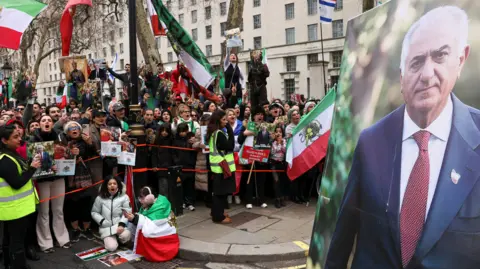
Hundreds of thousands of protesters took to the streets of US and European cities in February following Pahlavi's call for a "global day of action" in solidarity with protests that had swept across Iranian cities in December and January.
Tens of thousands of people were killed in the Iranian government's crackdown on those protests, with Trump on Tuesday putting the estimated casualties at 35,000.
Since the beginning of the conflict on Saturday, more than 1,700 targets have been struck in Iran, according to US Central Command, the combatant command that oversees the Middle East and parts of south and central Asia.
