US sending charter flight to bring Americans home from hantavirus cruise ship

 Getty Images
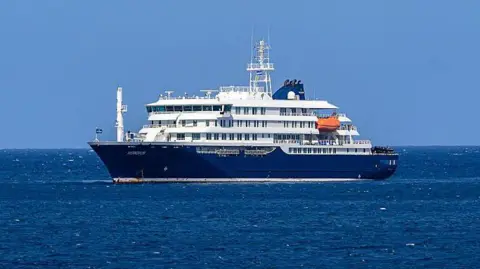
The US is sending a charter aircraft to bring home remaining Americans from a cruise ship where a hantavirus outbreak killed three people and infected several others, authorities say.
Officials say at least six US states are monitoring for possible cases after several passengers from the Dutch vessel MV Hondius returned home from the voyage.
The US Centers for Disease Control and Prevention (CDC) has classified the hantavirus outbreak as a "Level 3" emergency response, its lowest activation level.
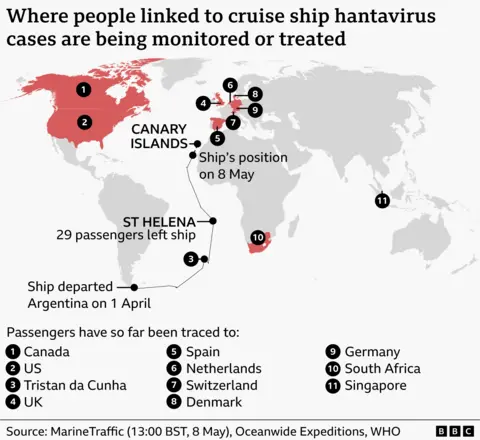
The luxury cruise, operated by Oceanwide Expeditions, departed from Ushuaia, Argentina, on 1 April and is due to arrive in Spain's Canary Islands on 10 May.
The CDC is sending staff to the Canary Islands to escort American passengers home on a charter flight, the agency said on Friday.
Another team of health experts will travel to Nebraska, where the passengers are expected to quarantine.
"The US government's top priority is the safe repatriation of American passengers," the CDC said in a statement.
The passengers will be evacuated on a US government medical repatriation flight to an air force base in Omaha, Nebraska, where they will then be transported to a quarantine center at the University of Nebraska, Omaha.
There are 17 Americans on board the cruise ship, according to its operator, Oceanwide Expeditions.
State health departments across the US are monitoring at least six passengers for possible infections, including two in Georgia, two in Texas, one in Virginia, one in Arizona and an unspecified number in California.
Oceanwide Expeditions said six Americans and more than two dozen other passengers disembarked in St Helena, a British territory, on 24 April.
Officials have confirmed five of the eight suspected hantavirus cases linked to the outbreak.
New Jersey Governor Mikie Sherrill said on Friday that two state residents may have been exposed during a flight with a passenger infected with hantavirus after leaving the cruise.
When the outbreak began, the CDC said the risk to the wider American public remained low.
"The Department of State is leading a coordinated, whole-of-government response including direct contact with passengers, diplomatic coordination, and engagement with domestic and international health authorities," the CDC said.
The agency also said the government was turning to its "premier health experts" to guide the response to the outbreak and that it was providing "technical assistance" to international partners.
The CDC did not respond to a BBC question about whether it had established a dedicated outbreak response team.
President Donald Trump said on Thursday that the outbreak was "very much, we hope, under control", and that his administration would provide a "full report" on it on Friday.
Officials have not yet confirmed how the outbreak began, but hantavirus is typically spread by rodents. People can become infected by breathing in air contaminated with virus particles from rodent urine, droppings or saliva.
The World Health Organization says the current outbreak is unlikely to become a pandemic like Covid-19 because this strain of hantavirus spreads through "close, intimate contact".
But the WHO warned that more cases could emerge because the disease has an incubation period of up to six weeks.
The outbreak comes after major staffing cuts at US health agencies under the Trump administration's cost-cutting push.
About 10,000 people were laid off across the Department of Health and Human Services agencies, including at the CDC and the National Institutes of Health, although some workers were later rehired.
In April, the administration also eliminated the CDC's full-time Vessel Sanitation Program staff, the team responsible for helping cruise ships prevent and manage disease outbreaks, CBS News reported.
Some health experts warn the US withdrawal from the WHO could hinder its response to the outbreak, as it would weaken access to international outbreak data and contact tracing needed to contain infections.
WHO officials said the CDC continues to share information, but some experts have cautioned that the loss of US funding to the UN agency has damaged the global disease surveillance network.
