Pain-free 'tripod' restraint brought in to Scottish jails
A new pain-free technique for restraining prisoners is being introduced across Scotland's jails.
The method removes the use of pain-inducing holds, such as bending back an inmate's wrists, and is designed to keep them on their feet, instead of forcing them to the floor.
It has been developed in response to human rights legislation and comes 10 years after the death of a prisoner who was restrained face down by up to 17 officers.
The Scottish Prison Service (SPS) said the technique would reduce injuries among prison officers and inmates and had proved to be highly successful in pilot schemes at three jails.
For more than 40 years, SPS staff have deployed a control and restraint method which was introduced in response to widespread violence in the country's jails.
Officers use "wrist flexion" to inflict pain in an attempt to bring the prisoner under control and inmates who struggle violently are often wrestled to the ground.
Last year saw 3,760 incidents where prisoners were restrained in Scotland's jails

 Marshall Family
The new technique builds on more modern methods used in social care and secure hospital settings.
Pilot schemes have been carried out with young offenders at HMP Polmont, female prisoners at HMP Stirling, and at HMP Low Moss, which holds almost 900 inmates, including convicted murderers.
If a prisoner has to be brought under control, two officers step in to hold them by the arms and wrists and restrict the movement of their legs, while a lead officer takes hold of the prisoner's head and brings it down to their upper chest.
The positions taken by the three officers creates the stability of a tripod, with the prisoner wedged in the middle.
The lead officer tries to talk to the prisoner to calm things down and the use of pain-inducing techniques is removed completely.
During a two-year trial at Polmont, the jail saw a 70% reduction in floor restraints and an 87% reduction in the use of pain-inducing holds.
No injuries were sustained by prisoners or staff at Polmont during the second year of the pilot.
The SPS believes it is the first prison service in the world to introduce pain-free restraint across its jails.
The old technique will still be used in life-threatening situations, or incidents where there is a risk of serious injury.
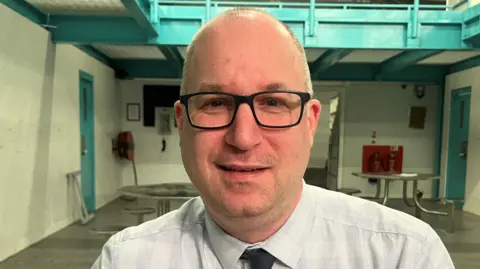
Dr Frank Slokan led the development of restraint reduction within the SPS and has written a PHD on the subject.
He said: "We found that the highest risk restraints are when you're on the floor.
"The use of wrist flexions and pain-inducing holds with individuals who are significantly mentally distressed or have used substances, can escalate situations.
"We've had a number of other prison services come to us and want to learn more about what we've been doing and that's not just in the UK, that's internationally."
'Calm approach'
Head of SPS operational resilience training, Iain Ramsay, said: "It's about the calm approach, understanding that these people have often faced massively traumatic experiences in their lives, that violence is maybe a part of their upbringing.
"Inflicting pain on that individual has no impact on them whatsoever because it's been the norm for them throughout their life.
"Controlling somebody and not actually applying that pain, gets them working with us quicker and gets them on side with us sooner."
Ramsay added: "Floor restraints have been reduced dramatically and the actual use of pain-inducing techniques have been reduced dramatically. This is going to be a lot safer for everybody involved."
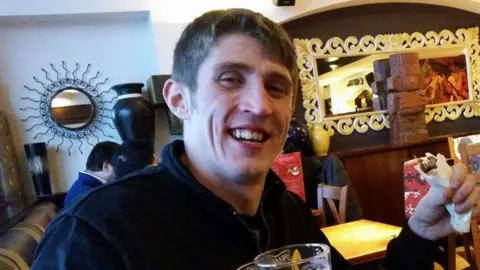
Allan Marshall, 30, was on remand at HMP Edinburgh in March 2015 when he was restrained on the floor of a cell block.
He died four days later.
Last year the Scottish Prison Service admitted his death was unlawful and apologised.
Allan's aunt, Sharon MacFadyen, said she was skeptical about the new restraint technique, adding his family lost all faith in the prison service long ago.
"It's 11 years today since it happened," she said.
"I know they're under pressure and they're overcrowded, but they need to get prison officers trained properly."
The Prison Officers' Association (POA) has backed what amounts to a major change but said it would need to be introduced with care and appropriate training.
The rollout of the new technique will start this year but the SPS said training all of its 3,500 frontline staff would take time.
 Marshall family
POA assistant chairman Phil Fairlie said: "We were a bit nervous and sceptical at the beginning as to whether this was going to work or not.
"What we've discovered is that we can take control of these situations, every bit as effectively as we used to do with the old control and restraint training.
"Particularly when we're as overcrowded as we are, we rely very heavily on the ability to maintain and keep positive relationships with prisoners and staff."
He added: "There's an added benefit in being able to keep a calm and controlled environment in the prison through the use of these techniques."
