What next for Yorkshire after end of hosepipe ban?

 Richard McCarthy/PA Wire
After the end of a five-month hosepipe ban in Yorkshire, experts have shed some light on what the future looks like for the region's water supplies.
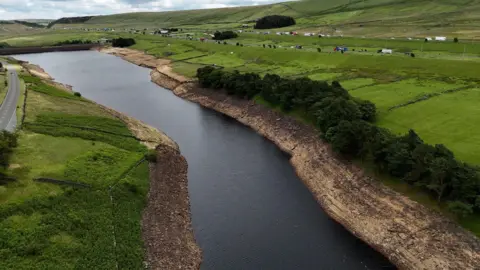
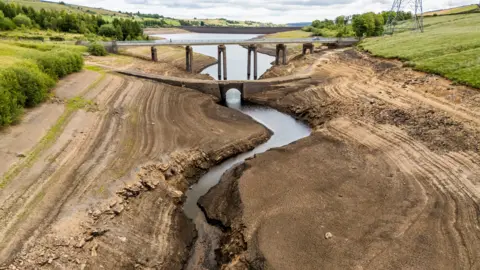
The restrictions were introduced in July after the driest spring in 132 years and a record-breaking hot summer, which caused reservoir levels in Yorkshire to drop to just 30% full.
However, November was found to be the fifth wettest in northern England since 1986 - a big enough switch for one water expert to describe it as "weather whiplash".
The BBC has spoken to several experts to find out what they believe is in store for Yorkshire's residents when it comes to the all important matter of our water supply.
Was 2025 an unusual year for rainfall?
According to Dr Megan Klaar, who is an associate professor in water and ecosystem resilience at The University of Leeds, 2025 has been a "real year of extremes".
"We've seen really low rainfall in Yorkshire in particular, so we saw less than half of what we would expect from about February all the way through to August - and only about 19% of our average in April," she said.
"We saw these really long dry periods and now we're seeing these really intense rainfall events, so there's just this huge extreme of events."
Dave Kaye, director of water at Yorkshire Water, said previously droughts had typically been a one-in-25-years event, but they were declared in both 2022 and 2025.
"It does go to show how the climate has changed," he said.
"We've also seen a very quick recharge this year, because when we first put the hosepipe restrictions in place, I wasn't expecting to lift them until 2026. Now we're able to lift them in December."
Are our water systems fit for purpose?
According to Dr Klaar, when there is not a lot of water it is hard to keep it in reservoirs, which means hosepipe bans are necessary.
"Then, when we see all of this rainfall, you can imagine the infrastructure is really struggling to deal with this extreme of nothing and then so much," she said.
During intense periods of rainfall, water runs off surfaces and into the sewage systems, which can get overwhelmed with the sheer volume of water.
"We see that a lot of it is not going through the sewage treatment works but is instead released into our rivers, as well as out into the sea," Dr Klaar explained.
 Danny Lawson/ PA Wire
Should we build more reservoirs?
Mr Kaye explained that although more reservoirs could be a solution to water shortages, they were expensive and time-consuming to build.
"The one that's being built down south is costing £6.9bn, and that won't go into supply until the late 2030s," he said.
"Reservoirs are the last option, purely because of the length of time and the cost of them."
Previous efforts, alongside Severn Trent Water, to expand one reservoir had to be halted due to "all the planning objections", Mr Kaye said.
John Vinson, from the Consumer Council for Water, said reservoirs could take more than 15 years to plan and build.
"It's really important that everything else is looked at first," he said.
What other solutions are there?
Dr Klaar said she thought water companies should move away from really large bodies of water and instead focus on lakes and ponds in areas upstream.
"This is where we see a lot of the rain coming from," she said.
"We could keep and hold that water in the landscape where it's safer and it's needed in those upland areas."
Meanwhile, Mr Vinson said: "Tackling leakage, making sure the network is resilient, means you can move water around different parts of Yorkshire Water's network to make sure that if one source goes a bit low, then you can move water in from somewhere else."
Mr Kaye said digging boreholes was a better option, which Yorkshire Water was doing in East Ness and Brayton.
"Groundwater supply is easy for us to do and it can be done much quicker," he added.
"The two we've got there, we'll get 21 million litres a day out of those."
 Paul Hudson/BBC
What impact do leaks have?
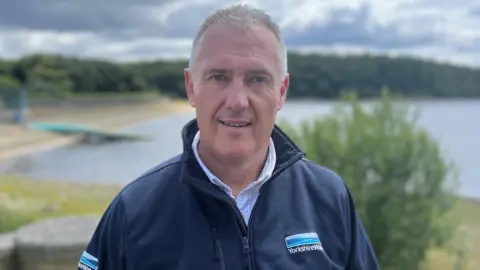
According to Mr Vinson, Yorkshire Water loses the equivalent of about 90 Olympic-sized swimming pools of water every day through leaks.
"Probably up to a third of that amount comes from customers' dripping taps and leaky loos, so it's up to everyone to do their bit," he said.
"If we do have more dry summers, it's important there's enough water to go around."
Mr Kaye said he understood why customers were frustrated by leakage and the water firm aimed to halve the amount of water lost in this way by 2050.
He estimated about 243 million litres of water were lost to leakage every day.
"We've fixed 11,000 leaks since the hosepipe restrictions went in and we fixed them faster," Mr Kaye added.
"We've put 100 extra colleagues into finding and fixing leaks, but it's still a problem and we're trying to drive it down as much as we can."
Should we expect hosepipe bans every year?
"We should not expect a hosepipe ban every year," Mr Vinson said.
"What we'd expect is Yorkshire Water working with agencies, such as the Environment Agency, to devise their system so it's a rare occurrence to have a hosepipe ban."
However, Dr Klaar warned we could still start seeing the bans more often due to the climate changing.
"We call it 'weather whiplash', when we start seeing these really long dry periods followed by these really intense rainstorms," she said.
"This is because our climate is warming and warmer air and a warmer climate means more water is being held in the atmosphere.
"So when it rains, we're going to get these really intense rainstorms."
Mr Kaye said he believed that despite climate change, long-term data suggested customers could get through 2026 without a ban.
"But I can't say what the weather's going to be like, or what the summer's going to be like," he said.
"We had eight months of dry weather. It was the driest weather on record, the warmest summer on record, and that's a result of climate change.
"I can't say what next year or 2027 is going to look like, but hopefully we're in a good position, certainly to get through 2026."
Listen to highlights from West Yorkshire on BBC Sounds, catch up with the latest episode of Look North.
